The first time I walked into the Acropolis Museum, I expected the usual museum experience — dimly lit rooms, roped-off displays, lots of squinting at tiny plaques. What I got instead was sunlight pouring through floor-to-ceiling glass, the actual Parthenon framed perfectly through the top-floor windows, and a 2,500-year-old marble girl smiling at me like she knew something I didn’t.
This museum doesn’t feel like a museum. It feels like someone cracked open the Acropolis and let you walk through its history in running shoes and air conditioning.
Here’s everything you need to know before you visit — from ticket prices to which floor deserves the most of your time.
Quick Facts#
| Location | 15 Dionysiou Areopagitou St, Athens (at the foot of the Acropolis) |
| Nearest metro | Acropoli station (Line 2, red line) — literally a 1-minute walk |
| Entry fee | €15 (full) / €10 (reduced) |
| Combined ticket | Not included in the €30 Acropolis combo ticket — separate purchase |
| Hours | Mon 9 AM–5 PM, Tue–Sun 9 AM–8 PM (summer: extended Fri to 10 PM) |
| Time needed | 1.5–2.5 hours |
| Best time to visit | Weekday mornings before 11 AM or Friday evenings |
| Photography | Allowed (no flash, no tripods) |
| Accessibility | Fully wheelchair accessible with elevators |
Tickets & Prices (2026)#
Let’s get straight to the numbers.
Standard Tickets#
| Ticket Type | Price | Who Qualifies |
|---|---|---|
| Full price | €15 | Adults |
| Reduced | €10 | EU seniors (65+), non-EU students |
| Free | €0 | Under 18, EU students with ISIC, disabled visitors + companion |
Important: The Acropolis Museum Is NOT on the Combo Ticket#
This catches people off guard. The €30 Acropolis combo ticket that covers the Acropolis hill and six other archaeological sites does not include the Acropolis Museum. They’re run by different organizations. You need a separate €15 ticket for the museum.
Where to Buy Tickets#
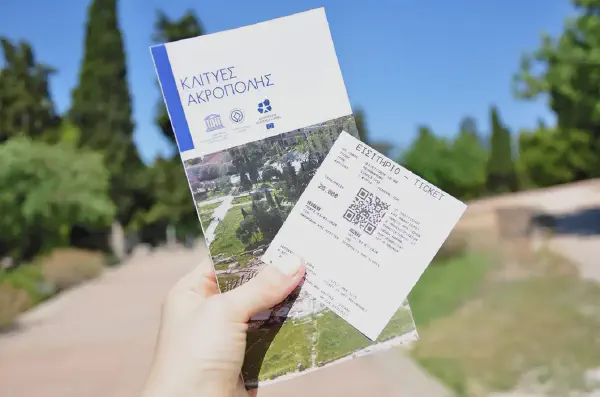
Online (recommended): Book through the official museum website to guarantee your time slot during peak season. No printout needed — show the QR code on your phone.
At the door: The ticket desk rarely has lines longer than 10 minutes, even in summer. This isn’t the Acropolis hill — you won’t wait an hour here. But Friday evenings and weekend mornings can get busy.
Free Entry Days#
- March 6 — Melina Mercouri Day
- April 18 — International Monuments Day
- May 18 — International Museum Day
- October 28 — Ohi Day
- First Sunday of the month (November–March)
The museum runs at maybe triple the normal capacity on free days. If you go, show up at opening.
Skip-the-Line Options#
Honestly, the museum ticket line is rarely a major problem by itself. Where skip-the-line tickets really shine is when they bundle the museum with a guided tour — you save time and get context that transforms the experience.
Skip-the-Line: Acropolis Museum Guided Tour
Includes skip-the-line entry + a 1.5-hour tour with a licensed archaeologist guide. They walk you through the highlights and explain the context you’d miss on your own. Best way to experience the museum if you’re short on time.
Guided Tours — Audio Guide vs. Private Tour#
You have three options here, and they suit different types of travelers.
Option 1: Self-Guided Visit (Free)#
Walk in, look around, read the panels. The museum’s layout is intuitive — it’s designed chronologically from bottom to top — so you won’t get lost. The signage is decent, with English translations on most displays.
The downside? You’ll stand in front of the Parthenon frieze and think “that’s cool” instead of understanding that you’re looking at a 160-meter-long comic strip depicting Athens’ most important religious festival, carved in the 440s BC under Pericles’ supervision. Context matters.
Option 2: Audio Guide (€5 at the entrance)#
A solid middle ground. The museum rents audio guides at the ground-floor desk, and they cover the key pieces across all three levels. Takes about 90 minutes at a comfortable pace.
Option 3: Guided Tour (Best Experience)#
If history is half the reason you’re in Athens, a guided tour of this museum is genuinely one of the best things you can do. A good guide turns fragments of marble into stories about real people — the girl who carried offerings to Athena, the warriors who fought at Marathon, the politicians who built the Parthenon partly as a flex.
Here are the tours I’d recommend:
Acropolis + Acropolis Museum Combo Guided Tour
Half-day tour covering both the Acropolis hill and the museum with one guide. The continuity is great — you see where the Caryatids originally stood on the hill, then meet the originals in the museum. Includes skip-the-line for both.
Athens Highlights Tour (Acropolis, Museum & City Walk)
Full-day best-of-Athens tour that includes the Acropolis, museum, Ancient Agora, and a walk through Plaka. Good option if you only have one or two days in Athens and want to see the essentials with expert commentary.
What to See: Floor by Floor#
The museum is built on three levels, each covering a different era. Think of it as a timeline — you start at the bottom with Athens’ earliest history and climb toward the Parthenon at the top. That architectural choice is deliberate. As you ascend, you’re literally approaching the Acropolis.
Ground Floor — The Slopes of the Acropolis#
What’s here: Artifacts found on the slopes surrounding the Acropolis hill — everyday objects, ritual items, and sculptures from sanctuaries that once dotted the hillside.
Don’t miss:
- The glass floor over the excavation. Right as you walk in, look down. You’re standing above an actual archaeological dig of an ancient Athenian neighborhood — houses, workshops, baths, all visible through the transparent floor. It’s immediately disorienting in the best way.
- Votive offerings from the Sanctuary of the Nymph — tiny ceramic vessels that Athenian brides dedicated before their weddings.
- Clay figurines and cooking pots that remind you: real people lived here, ate here, worried about their kids here.
Time needed: 20–30 minutes. It’s an excellent warm-up but not where you’ll spend the bulk of your visit.
First Floor — The Archaic Gallery#
What’s here: This is the museum’s emotional gut punch. Sculptures from the Archaic period (7th–5th century BC), including the famous Korai (maidens) and Kouroi (youths) that once decorated the Acropolis.
Don’t miss:
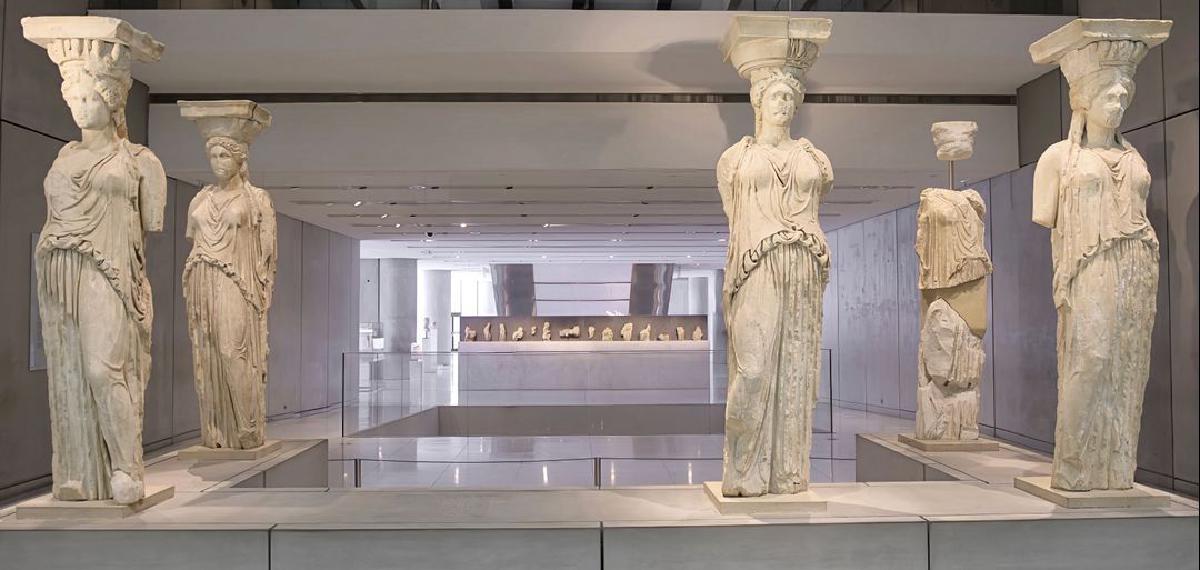
- The Caryatids. Five of the six original maidens that held up the Erechtheion porch — the sixth is in the British Museum (a whole conversation). They stand in a climate-controlled glass case, and seeing them up close is completely different from seeing the replicas on the hill. You can see the drape of their robes, the curves in their hair, the slight bend of the knee that makes them look like they’re about to take a step. They feel alive.
- The Moschophoros (Calf-Bearer). A marble statue from around 570 BC showing a man carrying a calf on his shoulders — an offering to Athena. His face has this calm, almost serene expression that’s stayed with me.
- The Peplos Kore. She’s smiling. That Archaic smile that art historians love to analyze, but in person it’s just… warm. She looks like she’s in on a joke.
- Traces of original paint. Look closely at several of the Korai — you’ll spot faint traces of red, blue, and green pigment. These statues were never meant to be bare white marble. They were painted in vivid colors. It completely reframes how you think about ancient Greece.
Time needed: 30–45 minutes minimum.
Top Floor — The Parthenon Gallery#
What’s here: The crown jewel. This entire floor is designed around the Parthenon frieze, metopes, and pediments — displayed at the same orientation and height as they were on the actual temple, which you can see through the glass walls.
Don’t miss:
- The Parthenon Frieze. The surviving panels of the 160-meter-long frieze that wrapped around the Parthenon. It depicts the Panathenaic procession — Athens’ grandest religious festival, with horsemen, musicians, sacrificial animals, and gods watching from Olympus. Gaps in the display mark panels that are still in the British Museum. The museum uses white plaster casts to show what’s missing — a quiet, pointed statement.
- The Pediment Sculptures. Fragments from the east and west pediments, showing the birth of Athena and the contest between Athena and Poseidon for patronage of Athens. These were the Parthenon’s headline acts — massive sculptures that filled the triangular gables at each end.
- The View. The gallery is rotated 23 degrees from the rest of the building to align exactly with the Parthenon. Stand near the glass wall and look up at the Acropolis — you’re seeing the same temple these sculptures came from, at the same angle. It’s one of the most powerful museum experiences I’ve had anywhere.
Time needed: 30–45 minutes.
7 Highlights You Absolutely Cannot Miss#
Here’s a quick hit list if you’re short on time:
- The Caryatids (First Floor) — The originals from the Erechtheion porch. One of the most iconic sculptural groups in history.
- The Parthenon Frieze (Top Floor) — 160 meters of narrative sculpture depicting the Panathenaic procession.
- The Glass Floor Excavation (Ground Floor) — An ancient neighborhood visible beneath your feet.
- The Peplos Kore (First Floor) — The smiling Archaic maiden with traces of original paint.
- The Parthenon Pediment Sculptures (Top Floor) — Monumental figures from the temple’s gables.
- The Moschophoros / Calf-Bearer (First Floor) — One of the oldest and most graceful Archaic sculptures.
- The Nike Adjusting Her Sandal (First Floor) — A delicate relief showing the goddess of victory in an intimate, human moment.
Tips for Visiting the Acropolis Museum#
Best Time to Visit#
- Weekday mornings (9–11 AM): Quietest time. You’ll have some galleries nearly to yourself.
- Friday evenings: Extended hours until 10 PM in summer. The top floor at sunset with the Acropolis lit up outside is spectacular.
- Avoid: Weekend afternoons and any day a cruise ship docks at Piraeus (usually Tuesday, Wednesday, Saturday in summer).
Beat the Crowds#
The museum gets around 1.5 million visitors per year. Peak months are June–September. My strategy:
- Visit the Acropolis hill first thing in the morning (8 AM opening)
- Walk down to the museum around 11 AM when the hill is getting crowded
- By the time hill visitors think about the museum, you’re already finishing up
Photography Rules#
- Photos and videos are allowed — no flash, no tripods, no selfie sticks
- The temporary exhibition hall sometimes has different rules — check the sign at the entrance
- Best photo spots: the Caryatids from the front, the Parthenon Gallery with the Acropolis visible through the glass, the glass floor from above
Accessibility#
The museum is one of the most accessible cultural sites in Athens:
- Elevators to all floors
- Wheelchair-accessible restrooms
- Ramps throughout
- Tactile exhibits for visually impaired visitors on select pieces
The Restaurant#
The museum’s second-floor restaurant has one of the best views in Athens — outdoor terrace looking straight up at the Acropolis. It’s not cheap (mains €15–22), but it’s genuinely good Greek food, not tourist-trap cafeteria stuff. Reservations recommended for dinner, especially Fridays.
Nearby Attractions#
The museum sits in one of Athens’ best neighborhoods for walking. Here’s what’s within 10 minutes on foot:
The Acropolis#
Obviously. The museum is literally at the base of the Acropolis hill. If you haven’t been up yet, go — it’s a 5-minute walk to the entrance. Read our complete Acropolis visiting guide for tickets, times, and tips.
Plaka & Anafiotika#
Plaka’s cobblestone lanes start right across the street. Wind through neoclassical houses, tiny tavernas, and souvenir shops. Then climb into Anafiotika — a hidden cluster of whitewashed Cycladic houses built by island workers in the 1840s. It feels like Santorini dropped into the middle of Athens.
The Ancient Agora#
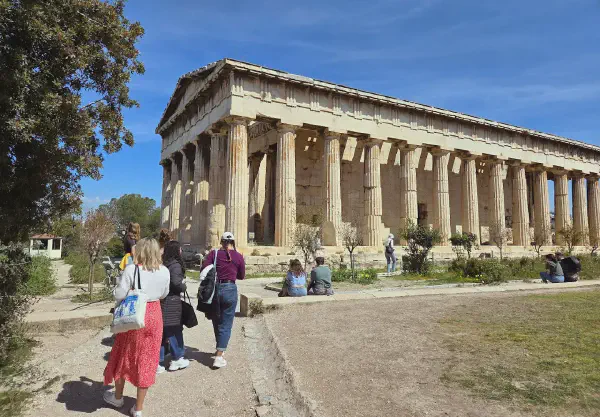
A 15-minute walk northwest takes you to the Ancient Agora — the civic heart of classical Athens where Socrates debated and democracy was born. The beautifully restored Temple of Hephaestus alone is worth the trip.
Hadrian’s Arch & Temple of Olympian Zeus#
Walk 5 minutes east to find Hadrian’s Arch and the massive columns of the Temple of Olympian Zeus — once the largest temple in Greece. Both are included in the Acropolis combo ticket.
Dionysiou Areopagitou Walkway#
The pedestrian boulevard that runs along the south slope of the Acropolis — one of the nicest walks in the city. Grab a coffee and stroll. The museum sits right on this street.
Planning your day? Check our one-day Athens itinerary or 3-day Athens itinerary for a complete route.
Tours We Recommend#
If you want a guided experience, here are our top picks — all include skip-the-line museum entry:
| Tour | Duration | Price | Best For |
|---|---|---|---|
| Museum Guided Tour | 1.5 hours | €39 | Museum-only visitors |
| Acropolis + Museum Combo | 4 hours | €69 | History lovers |
| Athens Highlights Tour | 7 hours | €89 | First-time visitors |
| Private Museum Tour | 2 hours | €140 | Families, small groups |
For more options including the Acropolis hill itself, see our full best Acropolis tours comparison.
Frequently Asked Questions#
How much are Acropolis Museum tickets in 2026?#
The standard adult ticket is €15. Reduced tickets (EU seniors, non-EU students) are €10. Children under 18 and EU students with valid ID get in free. The museum is not included in the €30 Acropolis archaeological sites combo ticket — it requires its own separate ticket.
What are the Acropolis Museum opening hours?#
Monday: 9 AM–5 PM. Tuesday–Sunday: 9 AM–8 PM. On Fridays during summer (April–October), the museum stays open until 10 PM. Hours may vary on public holidays — check the official site before you go.
Is the Acropolis Museum included in the combined ticket?#
No. The €30 Acropolis combined ticket covers the Acropolis hill and six other archaeological sites, but the Acropolis Museum is a separate institution with its own ticket. You’ll need to buy a €15 museum ticket separately.
How long do you need at the Acropolis Museum?#
Most visitors spend 1.5 to 2.5 hours. If you’re with a guide, plan for about 1.5 hours. If you’re exploring on your own and like to read every panel, you could easily spend 3 hours. A quick highlights visit (Caryatids + Parthenon Gallery) takes about 45 minutes.
Is the Acropolis Museum worth visiting?#
Absolutely — it’s one of the best museums in Europe, not just in Athens. The building itself is stunning, the Caryatids are breathtaking up close, and the Parthenon Gallery on the top floor is an experience you won’t get anywhere else. Even if you’re not usually a museum person, this one is different. It’s bright, modern, and tells a story that connects directly to the hill above.
Can you take photos in the Acropolis Museum?#
Yes. Photography and video are allowed throughout the permanent collection — no flash, tripods, or selfie sticks. The temporary exhibition space may have different rules. The best photo opportunities are the Caryatids, the glass floor excavation, and the Parthenon Gallery with the Acropolis framed through the windows.
Should I visit the Acropolis or the museum first?#
I’d recommend the Acropolis hill first, then the museum. You’ll see the original locations of the sculptures on the hill, then encounter the actual pieces in the museum — it gives the museum much more emotional weight. Plus, the museum has air conditioning, which you’ll desperately want after climbing the hill in summer. But if you’re visiting on a Friday evening, flip the order — start with the museum for the sunset light in the Parthenon Gallery.
Plan Your Visit#
The Acropolis Museum is one of those rare places that genuinely changes how you see a city. It takes the “impressive old ruins on a hill” and turns them into the story of a civilization — with faces, names, and beliefs that feel surprisingly relatable even 2,500 years later.
Pair it with a visit to the Acropolis itself, and you’ve got what I’d call the single best half-day experience in Athens.
More Athens planning: