The Ancient Agora is the part of Athens that tends to surprise people. Everyone arrives obsessed with the Acropolis, and fair enough, but the Agora is where the city starts to feel human instead of monumental. This is where Athenians traded, argued, voted, gossiped, worshipped, and tried to invent democracy while wearing sandals.
And unlike some archaeological sites that demand a lot of imagination, this one still gives you real architectural payoff: the Temple of Hephaestus is stunningly intact, the Stoa of Attalos has been reconstructed with unusual confidence, and the museum inside helps the whole place make sense.
If you are deciding whether to go, how much time to give it, or whether to combine it with the Acropolis, here is the practical guide I wish more travelers had before they walked in.
Ancient Agora Athens Quick Facts#
| Location | Adrianou 24, just below Monastiraki and Thissio |
| Best known for | Temple of Hephaestus, Stoa of Attalos, birthplace-of-democracy context |
| Time needed | 1.5 to 2.5 hours |
| Current official summer hours | 8:00 AM to 7:30 PM |
| Current official winter hours | 8:00 AM to 4:30 PM |
| Nearest metro | Thissio for the easiest walk, or Monastiraki if you want to combine nearby sights |
| Best for | History lovers, first-time Athens visitors, travelers doing a classical Athens day |
| Skip if | You only have a few hours in the city and care more about panoramic views than context |
What Was the Ancient Agora, Really?#
Calling the Ancient Agora a “marketplace” is technically true and emotionally incomplete.
Yes, people bought and sold things here. But this was also the civic engine room of Athens. Roads fed into it. Public offices stood around it. Philosophers passed through it. Political announcements happened here. Religious processions crossed it. Court business, trade, conversation, performance, and power all collided in the same space.
That is why the Agora lands differently from the Acropolis. The Acropolis feels ceremonial and elevated; the Agora feels lived in. When you walk through it, you are not just looking at temples. You are moving through the street-level machinery of the ancient city.
If you are building a first Athens itinerary, I would rank it just behind the Acropolis and right alongside the Acropolis Museum as one of the city’s essential classical sites.
Tickets, Prices, and How Booking Works#
This is the part travelers overcomplicate, mostly because the official Athens archaeology ticket system is not as intuitive as it should be.
Ancient Agora Ticket Basics#
As of April 2, 2026, the official Hellenic Heritage booking page for the Ancient Agora shows:
- A Single Ticket option
- A Combined Ticket option
- Timed-entry booking requirements
What the page does not clearly surface before date selection is every live price permutation, because pricing can change by visitor type, season, and selected bundle. In practice, you should expect to choose your date first and then confirm the exact amount during checkout.
My Recommendation on Booking#
- If you only want the Agora, buy the official timed entry ticket.
- If you also plan to visit the Acropolis and other major sites, compare the wider Athens combo options carefully before you pay.
- If you know you want interpretation, skip the cheapest bare ticket and book either an audio product or a guided visit. The Agora rewards context more than speed.
Ancient Agora E-Ticket and Audio Tour
Best for independent travelers who want the site explained without joining a group. You get pre-booked entry plus a smartphone audio tour, which makes a big difference in a site where the stories matter as much as the stones.
Is There an Acropolis + Agora Combined Ticket?#
Yes, but be precise about what you are buying.
There are currently combination-style products in the market that include the Acropolis plus the Ancient Agora and, in some cases, additional sites like the Roman Agora, Temple of Olympian Zeus, and more. Some are official archaeology bundles; others are reseller products with audio guides or extra inclusions attached.
That means you should not assume every “combo” is the same thing.
If you want a wider archaeology day and know you will visit multiple sites, a packaged option can make sense.
Acropolis Ticket with Optional Entry to 5 Other Sites
Best for travelers who want the Acropolis plus extra archaeological sites without piecing everything together manually. Ancient Agora access is included when you select the relevant expanded option, so check inclusions carefully before checkout.
Skip-the-Line: Worth It or Not?#
For the Ancient Agora alone, “skip-the-line” is less dramatic than at the Acropolis. You are usually not saving an hour of misery here. What you are really paying for is one of three things:
- ticket handling already done for you
- a smoother entry window
- actual interpretation from a guide or audio app
That is why I usually tell travelers this:
- Budget traveler: official ticket
- Independent but curious traveler: e-ticket + audio
- First-time Athens visitor: guided combo with the Acropolis
Opening Hours, Address, and How to Get There#
The official Ancient Agora page currently lists these hours:
- Summer (April 1 to October 31): 8:00 AM to 7:30 PM
- Winter (November 1 to March 31): 8:00 AM to 4:30 PM
Timed entry is in use, so even when the site is open all day, your arrival window still matters.
Address#
Adrianou 24, Athens 105 55
The main visitor area sits between Monastiraki, Thissio, and the pedestrian route below the Acropolis.
Easiest Way to Reach the Ancient Agora#
From Thissio metro: easiest. This is my preferred approach because the walk is short, flat, and visually clean.
From Monastiraki: also easy, and better if you want to pair the site with coffee, lunch, or shopping afterward. See our full Monastiraki neighborhood guide if that is part of your day.
On foot from the Acropolis: very doable. If you’re already following our self-guided walking tour of Athens, the Agora fits naturally into that route.
Temporary Entrance Note#
At least one current ticketed audio product notes that ongoing works can affect the main entrance, with access redirected to Apostolou Pavlou Street. Check your ticket confirmation the day before you go, because this is exactly the sort of detail that causes small but annoying delays.
What to See Inside the Ancient Agora#
This is not a site where you should just wander for ten minutes and leave. It rewards a loose route.
1. Temple of Hephaestus#
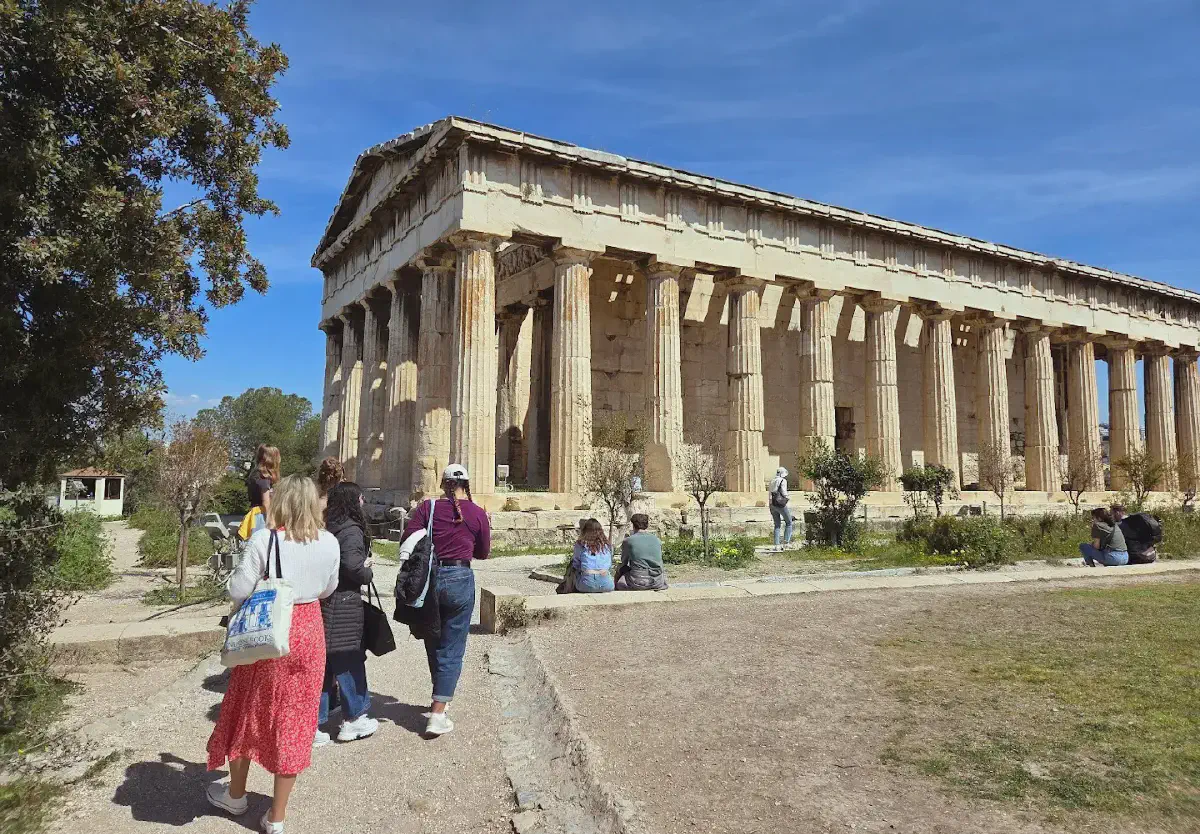
If the Parthenon is the celebrity, the Temple of Hephaestus is the overachiever.
It sits above the Agora on Kolonos Agoraios and is one of the best-preserved Doric temples in Greece. The proportions are elegant, the hillside setting is beautiful, and because it remains so intact, you can understand its form much more easily than at many fragmented sites.
It is dedicated to Hephaestus, god of metalworking and craft, which fits the area well because workshops once operated nearby.
Give this temple time. Walk around it slowly. Look back down across the site. This is one of the best photography points in the Agora, especially when the light is slanting rather than harsh.
2. Stoa of Attalos#
The Stoa of Attalos looks almost suspiciously complete because, in a sense, it is.
This long colonnaded building on the eastern edge of the Agora was reconstructed in the 1950s and now houses the Agora Museum. Purists can debate reconstruction philosophy all they want; as a visitor, it is incredibly useful. It lets you feel the scale of a grand Hellenistic stoa instead of just imagining a line on a site plan.
It is also where the visit starts to click. Suddenly the Agora stops being “ruins in a field” and becomes a functioning civic complex.
3. The Agora Museum#
Do not skip this museum, even if you think you are “not really a museum person.”
The collection is not overwhelming, and that is exactly why it works. It helps you read the site outside. You will see objects tied to public administration, voting, daily life, sculpture, religion, and the machinery of Athenian democracy. The museum also gives you relief from sun, wind, or fatigue at exactly the right moment in the visit.
If you are short on time, focus on the displays that connect directly to democratic life and civic process. Those are the pieces that make the Agora feel historically specific rather than vaguely ancient.
4. Monument of the Eponymous Heroes#
This is the kind of stop that can seem minor until someone explains it. The monument displayed notices and public information connected to the city’s tribes. In other words, it was partly an information board for civic Athens. That detail sounds small, but it captures what made the Agora different: politics here was not abstract. It was posted, debated, and seen.
5. Middle Stoa, South Stoa, and the Wider Administrative Ruins#
Some visitors breeze past these because the outlines are less visually dramatic. Slow down anyway.
The broad footprint of the stoas and public buildings helps you understand how dense and organized the Agora once was. This was not an empty ceremonial plaza with a few monuments dropped into it. It was an active urban organism.
6. Odeon of Agrippa#
The remains of this large Roman-era concert hall remind you that the Agora did not freeze in the 5th century BC. It kept evolving. That layering is part of what makes the site satisfying for repeat visitors: classical, Hellenistic, Roman, Byzantine, and modern excavation history all overlap here.
Guided Tours: Which Type Makes Sense?#
The Ancient Agora is one of those places where a guide can be worth the money, especially if it is your first trip to Athens.
Why? Because the core value of the Agora is not just visual. It is interpretive. You are paying to understand what happened here.
Best for First-Time Visitors#
If you want a clean, high-value half day, pair the Agora with the Acropolis and let one guide connect the dots.
Acropolis & Ancient Agora Guided Tour with All Entrances
Best for first-time visitors who want one coherent story rather than two separate ticketing exercises. Includes entry to both sites and works especially well if you would rather understand Athens once, properly, than piece it together in fragments.
Best for Travelers Who Want Depth but Not a Full-Day Commitment#
If the Agora itself is your real interest, a site-specific guided tour is a smarter buy than a giant city package.
- A dedicated Agora guide can explain how democracy actually functioned here.
- You get more attention on the Temple of Hephaestus and Stoa of Attalos.
- The 2-hour format is easier to fit around lunch, the Acropolis Museum, or a walk through Thissio.
How Long to Spend and the Best Visiting Strategy#
Minimum Time#
1.5 hours if you are moving efficiently and skipping long museum label-reading.
Ideal Time#
2 to 2.5 hours if you want the visit to feel complete instead of rushed.
Should You Combine It with the Acropolis?#
Usually, yes.
Here is the best practical strategy for most travelers:
- Acropolis early in the morning
- Coffee or a short break
- Ancient Agora late morning or early afternoon
- Monastiraki, Thissio, or the Acropolis Museum afterward
That sequence works because the Acropolis is more exposed, more crowded, and more physically demanding. The Ancient Agora feels calmer and greener, so it makes a good second act.
The exception: if you are a serious history traveler, do the Agora on a separate day or separate half-day. It deserves focus.
Nearby Sights Worth Adding#
Thissio#
Thissio is the easiest add-on. It has one of the nicest pedestrian atmospheres in central Athens, good coffee stops, and a relaxed post-site feel. This is where I would decompress after the Agora, especially if you visited in the heat.
Monastiraki#
If you want energy, lunch, rooftop views, or market browsing, head to Monastiraki. It is chaotic in a fun way and makes sense as your after-history reward.
Kerameikos#
If you are the kind of traveler who likes quieter archaeological sites and doesn’t need constant spectacle, Kerameikos pairs beautifully with the Agora. It adds another dimension to ancient Athens and usually comes with far fewer crowds.
Roman Agora#
If you like tidy itinerary logic, the Roman Agora is an easy follow-up because it is nearby and smaller. It makes a good “one more site before lunch” addition.
For bigger itinerary ideas, see our full list of things to do in Athens and the ticket strategy in our Acropolis guide.
Practical Tips Before You Go#
Go Early or Go Late#
Midday light can flatten the site visually and the heat builds fast from late spring onward. Early morning is best for clarity and comfort. Late afternoon gives softer light and a nicer atmosphere.
Wear Real Shoes#
This is not a flip-flop site. Paths are uneven, dusty, and occasionally slick in worn stone sections.
Bring Water, but Keep Expectations Sensible#
You will want water, especially from April through October. Drink before and after the visit too. This is still an archaeological site, not a leisure park.
Use Shade Strategically#
The Agora is greener than the Acropolis, but not shady enough to treat casually in summer. The Stoa is your friend.
Don’t Rush the Museum#
Even 20 focused minutes inside the Stoa of Attalos will improve the rest of your visit.
Photography Tip#
For your best Temple of Hephaestus photos, move slowly around the western side and look for tree-framed angles rather than trying to capture everything head-on.
Frequently Asked Questions#
Is the Ancient Agora better than the Roman Agora?#
For most travelers, yes. The Ancient Agora feels larger, richer, greener, and more important historically. The Roman Agora is worthwhile, but the Ancient Agora is the deeper experience.
Can you do the Ancient Agora without a guide?#
Yes, but it is one of the Athens sites where some kind of interpretation helps a lot. If you do not want a live guide, use an audio product.
Is the Ancient Agora included in the best Acropolis tours?#
Sometimes, but not always. Many Acropolis tours focus only on the hill and sometimes the museum. Check the inclusions line by line.
Is the Ancient Agora good for families?#
Yes, especially for families with older children who can handle a decent amount of walking. The open space and temple views help. Just avoid the hottest hours.
Is it worth visiting if I only have one day in Athens?#
If you care about ancient history, yes. Pair it with the Acropolis and skip lower-value filler activities.
Final Verdict#
The Ancient Agora is one of the most rewarding places to visit in Athens because it gives you the city at human scale. The Acropolis shows you what Athens wanted the world to see. The Agora shows you how Athens actually worked.
If you have even a moderate interest in history, go. If you are doing the Acropolis, strongly consider pairing the two. And if you usually find ruins a bit abstract, do yourself a favor and book either a good audio experience or a guided combo so the site opens up properly.
If you are planning the rest of your classical Athens day, read our guides to the Acropolis tickets and visiting strategy, the best Acropolis tours, and the Acropolis Museum next.