I wasn’t expecting much from Ancient Corinth. Honestly, I’d driven past it twice before on the way to Nafplio and never bothered stopping. “It’s just some Roman columns,” a friend told me. “You’ve already seen the Acropolis — what’s the point?”
Then I finally pulled over, bought a ticket, walked past the Temple of Apollo, and spent the next four hours wandering through ruins I couldn’t believe I’d been skipping. The agora where St. Paul was dragged before the Roman governor. The underground spring that’s been flowing for 2,600 years. And above it all, Acrocorinth — a fortress so massive it feels like it belongs in a different century on every level.
A Corinth day trip from Athens is one of the easiest escapes from the city. It’s 80 km away, the highway is fast, and you can combine the archaeological site with the Corinth Canal and a hike up to Acrocorinth in a single, very full day. Here’s everything you need to plan it.
Quick Overview#
| Detail | Info |
|---|---|
| Distance from Athens | 80 km (50 miles) |
| Travel time | ~1 hour by car, ~1.5 hours by bus |
| Half-day or full-day? | Half-day for ruins + canal; full day with Acrocorinth |
| Best time to go | March-May, September-November (cooler weather for hiking) |
| Ancient Corinth entry | €8 full / €4 reduced (2026, includes museum) |
| Acrocorinth entry | Free |
| Difficulty | Easy (site), moderate (Acrocorinth hike) |
Why Visit Ancient Corinth#
Most people zipping through the Peloponnese treat Corinth as a bathroom stop on the way to Nafplio. That’s a mistake.
Ancient Corinth was one of the wealthiest and most powerful city-states in Greece. At its peak, it rivaled Athens. The Romans destroyed it in 146 BC, then Julius Caesar rebuilt it as a Roman colony a century later — and it became even bigger. By the 1st century AD, it had a population of around 100,000 and was the capital of Roman Greece.
This is also where the Apostle Paul lived for 18 months around 50-51 AD, preaching to Greeks and Jews in the very agora you can walk through today. Those two letters in the New Testament — 1 Corinthians and 2 Corinthians — were written to the community he founded here. If that history means something to you, standing in the spot where Paul was brought before the Roman proconsul Gallio is a genuinely powerful experience.
But even if you’re not interested in the biblical connection, the site is impressive on its own. The Temple of Apollo — with seven monolithic columns still standing from 540 BC — is one of the oldest Doric temples in Greece. The Roman agora is massive. The Peirene Fountain, an elaborate underground spring, is unlike anything else you’ll see in the country.
And then there’s Acrocorinth above you. More on that later.
How to Get to Ancient Corinth from Athens#
You’ve got three main options.
Option 1: Rent a Car (Best Option)#
This is what I’d recommend. The drive is short, the highway is excellent, and having a car lets you stop at the Corinth Canal on the way and drive up to Acrocorinth without worrying about bus schedules.
Take the A8 motorway (Athens-Corinth highway) west from Athens. It’s one of the best highways in Greece — smooth, well-signed, and toll-managed. You’ll pass through a couple of toll stations (keep around €3-4 in coins or use a card). The exit for Ancient Corinth is clearly marked.
Total drive time: About 1 hour from central Athens, less from the western suburbs.
Parking: Free lot right at the archaeological site. Rarely full, even in peak season.
If you need a rental car, check rates on DiscoverCars — they compare all the major agencies at Athens Airport and downtown pickup points.
Option 2: KTEL Bus (Budget-Friendly)#
KTEL buses run frequently from Athens’ Kifissos (Terminal A) to the town of Corinth (Korinthos). The ride takes about 1.5 hours and costs around €9 each way.
Important: The bus drops you in modern Corinth town, not at the archaeological site. From the Corinth bus station, you’ll need a local bus or taxi (about 7 km southwest) to reach Ancient Corinth. Local buses run but are infrequent — check times at the station or ask the driver.
This works fine if you’re patient and on a budget. It doesn’t work well if you also want to visit Acrocorinth, because getting around without a car becomes time-consuming.
Option 3: Guided Tour from Athens (Easiest)#
If you’d rather not deal with driving or bus logistics, a guided tour handles everything. Most Corinth tours include the canal, the archaeological site, and sometimes a virtual reality or audio guide that adds context to the ruins.
Ancient Corinth Day Trip with Canal & VR Guide
Small group tour with air-conditioned minibus, Corinth Canal photo stop, full visit to Ancient Corinth with VR audio guide that reconstructs the site in its prime. Consistently top-rated, and the VR element genuinely adds something — especially for the agora and the shops along Lechaion Road.
Stop 1: The Corinth Canal#
If you’re driving from Athens, you’ll cross the Corinth Canal about 15 minutes before reaching Ancient Corinth. Pull over at the pedestrian bridge on the old national road — there’s a parking area and a viewing platform on both sides.
The canal is a 6.3 km cut sliced straight through solid rock, connecting the Saronic Gulf to the Gulf of Corinth. It’s only 24 meters wide. The walls rise 90 meters on either side, perfectly vertical, and the water far below is a surreal shade of blue-green. Ships pass through that look like they couldn’t possibly fit.
The idea to cut a canal here goes back to the tyrant Periander in the 7th century BC. Nero actually started digging in 67 AD with 6,000 Jewish prisoners of war — you can still see his excavation marks. But the canal wasn’t completed until 1893, by a French engineering company.
How long to spend: 15-20 minutes is plenty for photos and the view. There are a couple of souvenir shops and cafes on the bridge if you want a coffee.
For the adventurous: Bungee jumping from the canal bridge is a thing. Zulu Bungy operates jumps from the old rail bridge. It’s a 78-meter drop. I’ve watched people do it; I haven’t done it myself. You can check availability on their site if that’s your kind of day trip.
Stop 2: Ancient Corinth Archaeological Site#
The archaeological site is well-organized and surprisingly manageable. Unlike Delphi or the Athenian Agora, it doesn’t sprawl across a hillside or get tangled up with a modern city. Everything is in one place, and you can see it properly in 1.5-2 hours.
Temple of Apollo#
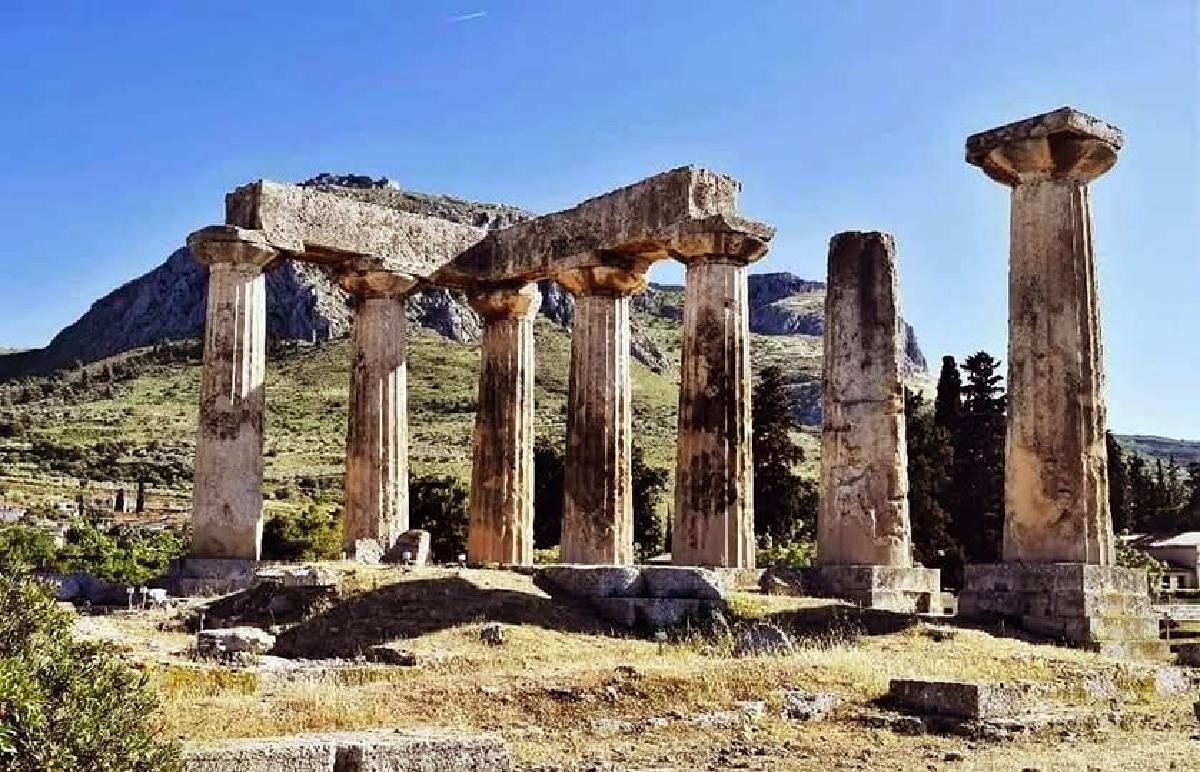
This is the first thing you see, and it’s the star of the site. Seven monolithic Doric columns still stand from the original temple, built around 540 BC — making it one of the oldest stone temples in Greece. The columns are thick, slightly tapered, and carved from single blocks of limestone. They’ve survived 2,500 years of earthquakes, sackings, and neglect, and they still dominate the skyline.
The temple sat on a low hill above the agora, deliberately positioned so it was visible from the harbor. When ships sailed into Lechaion port, this is what they saw first.
The Agora and Lechaion Road#
Below the Temple of Apollo, the Roman agora stretches out in a massive rectangle. This was the commercial and administrative heart of Roman Corinth — lined with shops (many of which you can still see), a basilica, and public buildings.
Lechaion Road runs north from the agora toward the ancient harbor. It was the main processional street, paved with limestone and flanked by colonnades. Walking it today, you can still see the ruts worn into the stone by centuries of cart traffic.
The Bema — a raised marble platform in the center of the agora — is traditionally identified as the place where St. Paul was brought before the Roman proconsul Gallio (Acts 18:12-17). Whether or not you’re a believer, it’s a tangible connection to a 2,000-year-old text that’s remarkable to stand on.
Peirene Fountain#
This is the hidden gem of the site. Peirene is an elaborate underground spring that’s been in continuous use since at least the 6th century BC. The Romans rebuilt it with arched chambers, marble facades, and a courtyard — and the underground chambers are still cool and dripping with water even in August.
According to myth, the spring was created when Pegasus struck the rock with his hoof. The more practical explanation is that it taps into a natural aquifer. Either way, it’s atmospheric and memorable — the kind of place where you realize the ancients weren’t so different from us in wanting their public water supply to look beautiful.
Archaeological Museum#
The on-site museum is small but excellent. Highlights include:
- Roman mosaics in remarkably good condition
- A collection of pottery and figurines from the archaic period
- Finds from the sanctuary of Asklepios (Corinth had its own healing center)
- Artifacts that illustrate daily life in Roman Corinth — weights, tools, coins, lamps
Give it 30-45 minutes. The air conditioning alone is worth it on a hot day.
Practical Information#
| Detail | Info |
|---|---|
| Opening hours | 8:00 AM – 8:00 PM (summer), 8:00 AM – 3:00 PM (winter) |
| Entrance fee | €8 full / €4 reduced (includes museum) |
| Free admission days | March 6, April 18, May 18, last weekend of September, October 28, first Sunday Nov-March |
| Estimated visit time | 1.5-2 hours |
| Facilities | Restrooms, water fountain, small shop |
Tip: Hours can change without much notice, especially in shoulder season. Check the official Hellenic Ministry of Culture site before you go.
Stop 3: Acrocorinth Fortress#
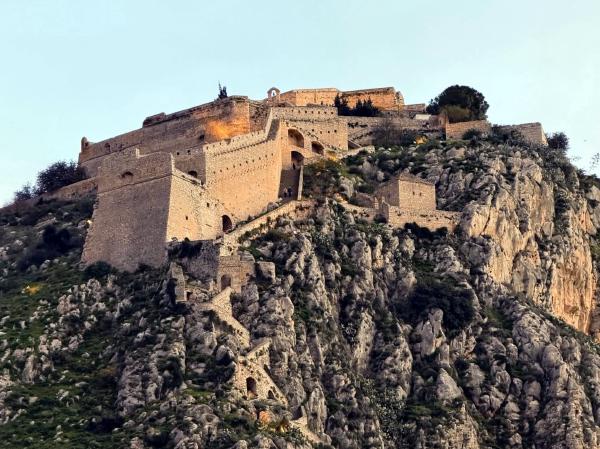
If you have the energy, Acrocorinth is the highlight of the day. It’s the massive fortress sitting on the 575-meter hill above Ancient Corinth, and it’s one of the most impressive fortifications in Greece — possibly in all of the Mediterranean.
The site has been fortified since at least the 7th century BC. What you see today is a layer cake of history: ancient Greek walls at the base, Byzantine towers in the middle, Frankish and Venetian additions higher up, and Ottoman modifications on top. Every power that controlled the Peloponnese wanted this hilltop, because whoever held Acrocorinth controlled the land bridge between mainland Greece and the peninsula.
Getting There#
By car: A winding road leads from the village of Ancient Corinth up to a parking area near the fortress gate. The drive takes about 10 minutes. The road is narrow but paved.
On foot: You can hike from the archaeological site, but it’s a steep 4 km climb. Only do this if you’re fit and have good shoes. Allow at least 45 minutes up.
What to See#
The fortress has three gates — you pass through all three to reach the interior. Inside, it’s massive and mostly ruined, but the exploration is the point. Highlights:
- The triple gates — each one from a different era (Ottoman, Frankish, Byzantine)
- The upper citadel with views that stretch to the mountains of the central Peloponnese, the Gulf of Corinth, and on clear days, mainland Greece to the north
- The Temple of Aphrodite foundations at the summit — in antiquity, this was one of the most famous temples in Greece (the source of Corinth’s reputation for sacred prostitution, though historians debate the details)
- Ottoman mosque and fountain partway up
- Byzantine chapel of the Panagia
Practical Tips for Acrocorinth#
- Entry is free — always has been, hopefully always will be
- Wear proper shoes. The paths inside are uneven rock and loose gravel
- Bring water. There’s nothing to buy once you’re inside the walls
- Allow 1-1.5 hours for a proper exploration
- Best light for photos: Late afternoon, when the stone glows golden
- It’s exposed. No shade inside the fortress. In summer, go early morning or late afternoon
Combining Corinth with Other Destinations#
The beauty of Corinth’s location is that it sits right at the gateway to the Peloponnese. You can easily combine it with other stops:
Corinth + Nafplio (Full Day)#
Drive from Athens to the Corinth Canal (15 min stop), then Ancient Corinth (1.5-2 hours), then continue south to Nafplio (45 min drive). Spend the afternoon exploring Nafplio’s old town and waterfront. This is a great combo if you want both ancient history and a charming coastal town.
Corinth + Mycenae + Epidaurus (Long Full Day)#
This is the classic Peloponnese combo tour. It’s doable in a day with a car, but it’s a lot. Check our Peloponnese day trips guide for the logistics of this route.
Corinth Canal + Ancient Corinth Only (Half Day)#
If you don’t want to spend a full day, the canal plus the archaeological site work perfectly as a morning or afternoon trip. You’ll be back in Athens by lunchtime (or in time for dinner).
Where to Eat Near Ancient Corinth#
The village of Ancient Corinth has a handful of tavernas right near the archaeological site. Don’t expect fine dining — this is simple, honest, Greek village food.
Taverna Marinos — Right on the main road near the site entrance. Solid grilled meats, fresh salads, reasonable prices. The kind of place where the owner might bring you a free dessert.
Tasos — Slightly more polished than the typical village taverna. Good moussaka, excellent grilled lamb chops. Outdoor seating with a view toward the fortress.
For coffee and a snack: There are a couple of kafeneia (traditional coffee shops) in the village square. Order a Greek coffee, sit under the plane trees, and watch the locals argue about football. It’s part of the experience.
If you’re heading to Nafplio after, save your appetite — the restaurant scene there is significantly better.
Tips for Your Visit#
What to wear: Comfortable walking shoes are non-negotiable, especially if you’re doing Acrocorinth. A hat and sunscreen are essential from May through September — the site has almost no shade.
How long to spend:
- Corinth Canal: 15-20 minutes
- Ancient Corinth + museum: 1.5-2 hours
- Acrocorinth: 1-1.5 hours (plus 10-minute drive or 45-minute hike from the site)
- Total with all three: 4-5 hours plus driving time
Best time of year: Spring (March-May) and autumn (September-November) are ideal. Summer works but the heat at Acrocorinth is punishing. Winter hours are shorter but the sites are nearly empty.
Photography: The Temple of Apollo photographs best in morning light. Acrocorinth is best in late afternoon. If you can only choose one golden-hour slot, pick Acrocorinth — the views at sunset are extraordinary.
Frequently Asked Questions#
Is Ancient Corinth worth visiting?#
Yes — especially if you’re interested in Roman history, early Christianity, or Greek archaeology beyond the obvious Athens highlights. The Temple of Apollo is genuinely impressive, the Peirene Fountain is unique, and Acrocorinth is one of the best fortress experiences in Greece. It’s also much less crowded than Delphi or Mycenae.
How do I get from Athens to Ancient Corinth without a car?#
The easiest option is a KTEL bus from Athens’ Kifissos (Terminal A) to Corinth town (~€9, 1.5 hours), then a local bus or taxi to the archaeological site (7 km). Alternatively, book a guided tour from Athens that includes transport, the canal stop, and the site visit.
Can I visit Ancient Corinth and Acrocorinth in the same day?#
Absolutely. The two sites are right next to each other — Acrocorinth is a 10-minute drive (or 45-minute hike) from the archaeological site. Allow a full morning or afternoon for both. Just bring water and proper shoes for the fortress.
Is there a train to Ancient Corinth from Athens?#
The Proastiakos (suburban rail) runs from Athens to the town of Kiato, stopping in New Corinth. The ride takes about 1.5 hours. From New Corinth station, you’ll need a taxi to the archaeological site (about 7 km, ~€10-12). It’s cheaper than driving but less convenient than the bus for the final leg.
What’s the difference between Corinth and Ancient Corinth?#
Modern Corinth (Korinthos) is a regular Greek city rebuilt after a devastating earthquake in 1858. Ancient Corinth is the archaeological site about 7 km southwest, in the village of Archaia Korinthos. The two are completely different places — make sure you’re heading to the right one.
Final Thoughts#
Ancient Corinth is one of those places that rewards the traveler who slows down. You can race through the site in 30 minutes, tick the box, and get back on the highway. Or you can spend a morning wandering the agora, descending into the Peirene Fountain, and then hiking up to Acrocorinth to watch the Peloponnese spread out below you like a map.
I’d recommend the second approach. This is a place with 3,000 years of stories layered into the stone, and it deserves more than a quick photo of seven columns.
For more ideas on what to see beyond Athens, check out our guide to the best day trips from Athens or dive deeper into the Peloponnese with our Peloponnese day trips guide.
This article contains affiliate links. When you book through our links, we earn a small commission at no extra cost to you. This helps us keep creating free, honest Athens travel content. See our disclosure page for details.