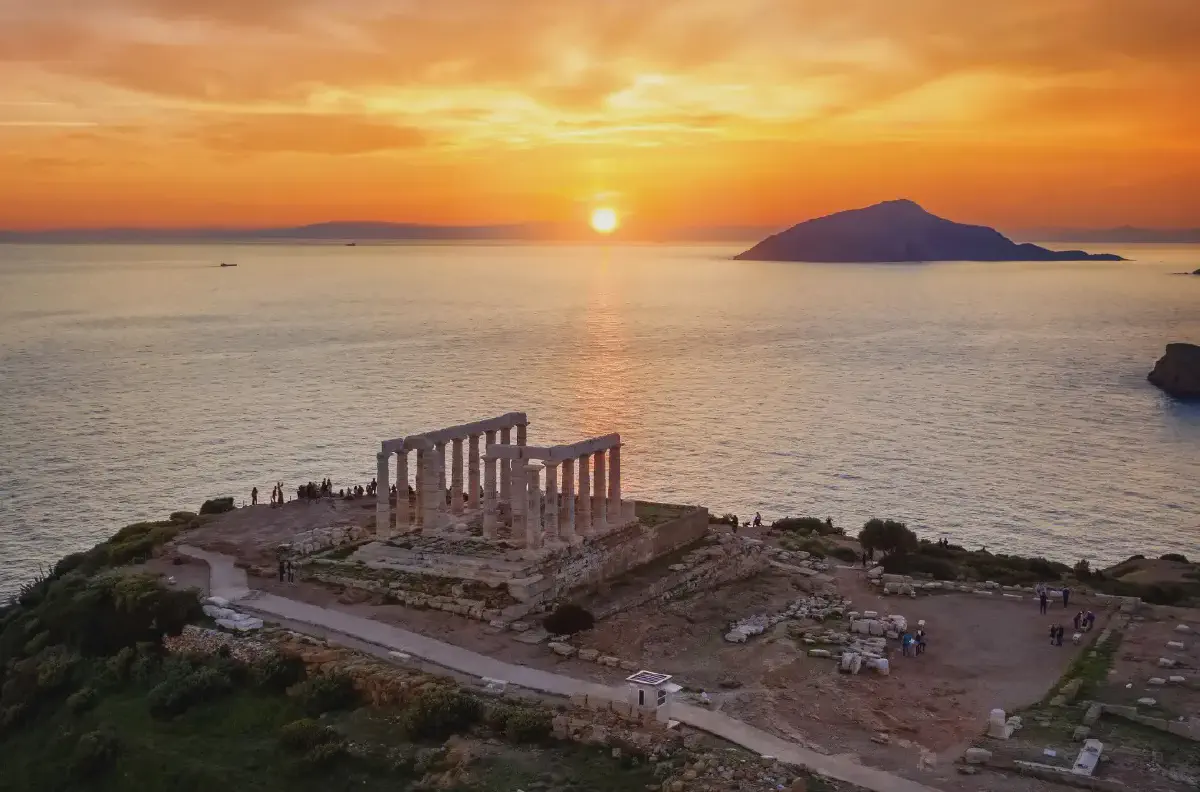
There’s a moment at Cape Sounion — right around 7:30 in the evening in summer — when the sun hits the marble columns of the Temple of Poseidon and the whole thing glows amber against a deep blue sea. Nobody talks. Everyone just watches. I’ve seen it three times now and I still get chills.
A Cape Sounion day trip from Athens is one of the easiest and most rewarding half-day excursions you can make. It’s only 70 km from the city center, the coastal drive is stunning, and the payoff — an ancient temple on a cliff 60 meters above the Aegean — is the kind of thing that makes Greece feel like Greece.
Here’s everything you need to know to plan your visit.
Quick Overview#
| Detail | Info |
|---|---|
| Distance from Athens | 70 km (43 miles) |
| Travel time | 1-1.5 hours by car, ~2 hours by bus |
| Half-day or full-day? | Half-day (4-5 hours total) |
| Best time to go | Late afternoon for sunset |
| Entrance fee | €10 (2026) |
| Opening hours | 9:00 AM – sunset |
| Difficulty | Easy — flat site, paved paths |
Why Visit Cape Sounion#
Let’s be clear about what Cape Sounion is and isn’t. It’s not a sprawling archaeological complex like Delphi or the Acropolis. There’s one temple, a small stretch of ruins, and a cliff. That’s it.
But here’s why people keep going back: location.
The Temple of Poseidon sits on the southernmost tip of the Attica peninsula, perched on a rocky headland with 270-degree views of the Aegean Sea. On a clear day you can see the islands of Kea, Kythnos, and even Serifos in the distance. Ancient sailors used it as a landmark — they could spot those white columns from far out at sea.
It’s also one of the best-preserved temples in Greece. Fifteen of the original 34 Doric columns are still standing, which doesn’t sound like a lot until you remember the temple was built around 440 BC. That’s 2,400 years of earthquakes, wars, and weather.
And then there’s the sunset. Cape Sounion’s western exposure means you’re watching the sun drop directly into the sea, with nothing between you and the horizon except blue water. It’s routinely listed among the best sunsets in Greece, and honestly, it earns it.
How to Get to Cape Sounion from Athens#
You’ve got three main options: public bus, organized tour, or renting a car. Each has clear advantages.
Option 1: KTEL Bus (Budget-Friendly)#
The cheapest way to get there. KTEL Attikis operates a regular service from Athens to Sounion along the scenic coastal road.
The details:
- Departure point: Mavromateon terminal (near Pedion tou Areos park, close to Victoria metro station)
- Route: The bus takes the coastal road via Glyfada, Vouliagmeni, and Lavrio — it’s a beautiful ride
- Duration: About 2 hours (it makes stops along the coast)
- Cost: ~€7 each way (2026 prices)
- Frequency: Roughly every 1-2 hours, with more departures on weekends
Tips for the bus:
- Check the return schedule before you go. Buses don’t run late, and the last one back typically leaves Sounion around 7-8 PM
- Sit on the right side going there for the best coastal views
- The bus drops you at the entrance to the archaeological site
Option 2: Organized Tour (Most Convenient)#
If you’d rather not deal with bus schedules — especially if you want to catch sunset and get back without worrying about the last bus — a tour is the easiest option.
What you get:
- Hotel pickup and drop-off in central Athens
- Air-conditioned minibus or coach
- English-speaking guide who covers the history and mythology
- Usually a swim stop at a beach along the way
- Timed for sunset (the good tours are)
What it costs: €50-70 per person for a half-day sunset tour. Some premium small-group tours run €80-100.
Check availability for Cape Sounion sunset tours on GetYourGuide — the half-day sunset options tend to sell out in peak season, so booking a few days ahead is smart.
Who it’s best for: Solo travelers, couples who want to relax, anyone who doesn’t want to drive in Athens traffic, and first-time visitors who’d appreciate the historical context from a guide.
Option 3: Rent a Car (Most Flexible)#
This is my personal favorite. The drive from Athens to Cape Sounion along the Apollo Coast is one of the most scenic in Attica, and having a car means you can stop at beaches, tavernas, and viewpoints along the way.
The route:
- Take the Athens-Sounion coastal road (Leof. Poseidonos / EO91)
- It follows the coastline through Glyfada, Voula, Vouliagmeni, Varkiza, Saronida, and Lagonisi
- Total distance: about 70 km, takes 1-1.5 hours without stops
Parking: There’s a free parking lot at the archaeological site. It fills up for sunset, so arrive by 5-6 PM in summer.
Cost: Car rental from Athens runs €25-45/day depending on the season. Compare car rental prices on DiscoverCars — they aggregate local Greek agencies alongside the international chains, which usually means better rates.
Temple of Poseidon: History and What to See#
The Temple of Poseidon was built between 444 and 440 BC — roughly the same period as the Parthenon. It was part of the “Golden Age” building program under Pericles, which makes Cape Sounion one of the most important archaeological sites of classical Athens.
What’s Still Standing#
The temple is a Doric peripteral structure, meaning it was surrounded by a colonnade. Of the original 34 columns, 15 are still upright. They’re thinner than typical Doric columns — the architect used a slightly different design, possibly to reduce wind resistance on this exposed clifftop.
The columns are made from local Agrileza marble, which has a distinctive white-grey tone. At sunset, they turn gold.
Byron’s Inscription#
On one of the columns near the entrance, you can spot a carved graffiti: “BYRON.” Yes, that Byron. Lord Byron visited in 1810 during his Grand Tour of Europe and carved his name into the marble. It’s since been roped off (for obvious reasons — please don’t add yours), but you can still see it from behind the barrier.
The visit inspired several of his poems, including a passage in Don Juan:
“Place me on Sunium’s marbled steep, Where nothing, save the waves and I, May hear our mutual murmurs sweep…”
The Surrounding Ruins#
Beyond the temple itself, you’ll find:
- Foundations of the Propylaea (the ancient gateway)
- Remains of a ship shed — this was an important naval lookout point
- A small sanctuary of Athena Sounias (about 500 meters northeast, often missed by visitors)
- Ancient fortification walls visible along the headland
Most people spend 45 minutes to 1.5 hours at the site, depending on how long they linger for sunset.
Opening Hours and Ticket Prices (2026)#
| Season | Hours |
|---|---|
| April – October | 9:00 AM – sunset (closing time varies) |
| November – March | 9:30 AM – 5:00 PM |
Ticket prices:
- Full price: €10
- Reduced: €5 (EU students, seniors 65+)
- Free: Under 18, certain museum pass holders
The site closes when the sun sets — they clear visitors about 15-20 minutes after sunset. So if sunset is at 8:30 PM, expect to leave by 8:45-8:50 PM.
Best Time to Visit Cape Sounion#
For Sunset (The Main Event)#
This is what Cape Sounion is famous for. The sun sets directly over the sea to the west, and from behind the temple columns, it’s genuinely one of the most photogenic moments in Greece.
Sunset times by month (approximate):
| Month | Sunset Time |
|---|---|
| April | 7:45 PM |
| May | 8:15 PM |
| June | 8:45 PM |
| July | 8:40 PM |
| August | 8:15 PM |
| September | 7:30 PM |
| October | 6:45 PM |
Arrive at least 1 hour before sunset to get your tickets, explore the temple, and find a good spot. The western side of the temple platform is where everyone gathers — it gets crowded in July and August, but there’s enough space along the cliff edge for everyone.
For Fewer Crowds#
If crowds aren’t your thing, visit in the morning (before 11 AM) or come in the shoulder season (April-May or September-October). Midweek is always quieter than weekends.
The temple is beautiful in the morning light too — the columns catch the eastern sun, and you’ll have the place nearly to yourself.
Seasons to Consider#
- Summer (June-August): Hot, crowded at sunset, but the longest visiting hours. Bring water and sunscreen — there’s almost no shade at the site.
- Spring (April-May): My favorite time. Wildflowers on the hillside, comfortable temperatures, smaller crowds.
- Autumn (September-October): Still warm, great light, and the summer crowds have thinned.
- Winter (November-March): Atmospheric but cold and windy. Shorter hours. Check that the site is open before making the trip.
What Else to Do Near Cape Sounion#
Cape Sounion isn’t just the temple. If you’ve got a car (or some flexibility with your schedule), there are some excellent stops nearby.
Beaches Below the Temple#
There are two small beaches at the base of the cape:
- Sounion Beach — right below the archaeological site, pebbly but swimmable. Free access.
- Aegeon Beach — a slightly more organized beach nearby with sunbeds (€8-10/set).
After an afternoon at the temple, a quick swim before the drive back is a perfect way to cool off.
The Apollo Coast#
The entire coastal road from Athens to Sounion is lined with beaches worth stopping at:
- Vouliagmeni Beach — upscale, organized, crystal-clear water
- Kavouri Beach — more local, less touristy
- Lagonisi — a quieter stretch with several tavernas right on the water
Lavrio Port#
If you’re interested in island hopping, Lavrio is just 10 km north of Cape Sounion. Ferries run from here to Kea and Kythnos — two gorgeous Cycladic islands that are far less touristy than Mykonos or Santorini.
Thorikos Ancient Theatre#
About 8 km north of Sounion, near Lavrio, lies the oldest known theatre in Greece (older than the Theatre of Dionysus in Athens). It’s free to visit and usually deserted. A genuinely cool detour for history buffs.
Where to Eat Near Cape Sounion#
There’s a café at the archaeological site, but it’s overpriced and not great. Here are better options:
Right at Sounion:
- Aegeon Restaurant — The closest proper taverna to the temple. Grilled fish, salads, decent house wine. Nothing fancy, but the sea-view terrace makes up for it. Budget €15-25 per person.
Along the coastal road (on the drive back):
- Island Club Restaurant (Varkiza) — Beachfront with excellent fresh fish. A bit pricier but worth it for a special dinner.
- Psarotaverna Lagonisi — Classic Greek fish taverna. Order whatever’s fresh, get a carafe of white wine, and watch the boats.
In Lavrio (10 min north):
- Ouzeri Tou Yianni — Small, local, excellent meze and ouzo. The kind of place where the menu changes daily based on the catch.
Self-Drive vs. Tour: Which Should You Choose?#
This is the question everyone asks, so let me break it down honestly.
| Factor | Self-Drive | Organized Tour |
|---|---|---|
| Cost (2 people) | €35-50 (rental + fuel + parking) | €100-140 |
| Cost (solo) | €35-50 | €50-70 |
| Flexibility | Total — stop anywhere, stay as long as you want | Fixed itinerary |
| Sunset timing | You control it | Good tours time it perfectly |
| Driving in Greece | Fine on the coast road, can be stressful in Athens | Not your problem |
| Commentary/history | Bring a guidebook or audio guide | Guide explains everything |
| Beach stops | Yes, wherever you want | Some tours include one |
| Alcohol at sunset | Not if you’re driving | Yes (some tours offer wine) |
My recommendation:#
- Book a tour if: You’re solo, you don’t want to deal with driving, you want a guide’s historical context, or you want to drink wine at sunset. Browse Cape Sounion tours on GetYourGuide for the most reviewed options.
- Rent a car if: You’re traveling as a couple or group (better value), you want to stop at beaches, you like having full control of your schedule, or you’re combining Sounion with other stops along the coast. Compare car rental deals on DiscoverCars — booking online in advance is almost always cheaper than renting at the airport.
Practical Tips for Visiting Cape Sounion#
Here’s the stuff that isn’t in the guidebooks:
- Wear comfortable shoes. The ground is rocky and uneven around the temple. Sandals work but closed-toe shoes are better.
- Bring water. There’s a kiosk at the entrance but it charges tourist prices. Fill a bottle before you leave Athens.
- Sunscreen is non-negotiable in summer. There is almost zero shade at the site. Zero.
- Wind is real. Cape Sounion is an exposed headland. It can be surprisingly breezy, even in summer. Bring a light layer for sunset — once the sun drops, it cools down fast.
- Photography tip: For the best sunset shots, position yourself to the southeast of the temple so the columns are between you and the sun. The silhouette is what you’re after.
- Don’t rush. Budget at least 1.5 hours at the site if you’re there for sunset. That gives you time to explore, take photos, and find a good spot before the crowd builds.
- Cash and cards both work at the ticket booth and the café.
- Skip the audio guide. It exists, but it’s not worth the extra €5 — there are good free resources online, and the signage at the site is decent.
Combining Cape Sounion with Other Day Trips#
Cape Sounion is a half-day trip, which means you can combine it with other activities:
- Morning at a beach + afternoon at Sounion: Swim at Vouliagmeni or Varkiza beach in the morning, then head to Sounion for sunset. Perfect summer day.
- Sounion + Lavrio + Kea ferry: If you’re heading to the Cycladic islands, drive to Sounion in the morning, then continue to Lavrio for an afternoon ferry to Kea.
- Athens sightseeing + Sounion sunset: Spend the morning at the Acropolis or the Acropolis Museum, then take a late-afternoon tour to Sounion.
For more options, check our full guide to the best day trips from Athens.
Frequently Asked Questions#
How long does it take to visit Cape Sounion?#
Most visitors spend 45 minutes to 1.5 hours at the archaeological site. If you’re there for sunset, plan for about 2 hours total — you’ll want to arrive early to explore before the main event. Add travel time (1-2 hours each way depending on your transport), and you’re looking at a 4-6 hour half-day trip.
Is Cape Sounion worth visiting without a sunset?#
Yes, absolutely. The temple and the coastal views are impressive at any time of day. Morning visits are actually great — fewer people, beautiful light, and you’ll feel like you have the place to yourself. That said, the sunset is the signature experience, so if you can time your visit for late afternoon, do it.
Can I swim at Cape Sounion?#
Yes. There are small beaches at the base of the cape where you can swim. They’re pebbly, not sandy, but the water is clean and beautifully clear. Bring a towel and swimsuit if you want to take a dip before or after visiting the temple.
Is Cape Sounion suitable for children?#
It is, with some caveats. The site itself is easy to walk, but the cliffs are high and not always fenced. Keep a close eye on young children near the edges. The bus ride can feel long for small kids — driving is more flexible. Most children find the temple itself interesting for about 20-30 minutes.
Do I need to book tickets in advance?#
No. Tickets are sold at the entrance and there are rarely long queues. Even in peak summer, the wait is usually under 10 minutes. Just show up and buy your ticket.
What’s the best way to get to Cape Sounion without a car?#
The KTEL bus from Mavromateon terminal in Athens is the cheapest option (~€7 each way, about 2 hours). For more convenience, a half-day organized tour includes pickup, transport, and a guide for €50-70 per person. See tour options on GetYourGuide.
Planning the rest of your Athens trip? Check our 5-day Athens itinerary for a day-by-day breakdown, or browse where to stay in Athens to find the best neighborhood for your style.