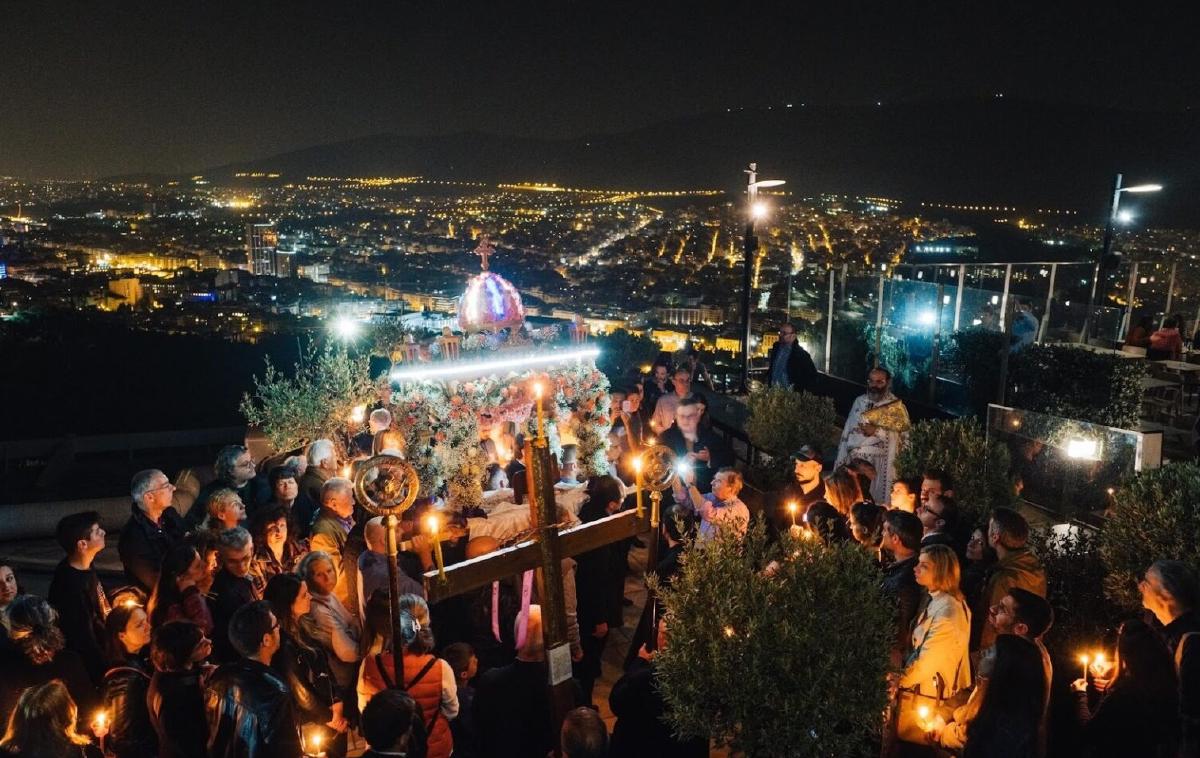
Greek Easter is not like any Easter you have experienced before. Forget chocolate eggs and Sunday brunch. This is a week-long build-up of fasting, candlelit processions through darkened streets, a midnight Resurrection service that erupts in fireworks and church bells, and then a Sunday feast centered around a whole lamb turning slowly on a spit while families gather on balconies and in parks across the city.
It is the most important celebration in the Greek calendar — bigger than Christmas, more emotional than New Year’s, and one of those rare cultural moments that genuinely moves people who witness it, whether they’re Greek or not.
In 2026, Greek Orthodox Easter Sunday falls on April 12. If you’re in Athens during Holy Week, here’s everything you need to know.
When Is Greek Easter?#
Greek Orthodox Easter follows the Julian calendar, which means it usually falls on a different date than Western Easter. Sometimes the two coincide; in 2026, they’re one week apart.
| Date (2026) | |
|---|---|
| Western Easter | April 5 |
| Greek Orthodox Easter | April 12 |
| Palm Sunday | April 6 |
| Good Friday (Megali Paraskevi) | April 10 |
| Holy Saturday (Megalo Savvato) | April 11 |
| Easter Sunday (Pascha) | April 12 |
| Easter Monday | April 13 |
Holy Week in Athens: Day by Day#
Palm Sunday (April 6)#
The start of Holy Week. Churches are decorated with palm crosses and bay leaves, and services are held across the city. The atmosphere is still calm — the intensity builds through the week. You’ll notice Athenians shopping for Easter preparations: red eggs, tsoureki bread, lamb.
Holy Monday to Thursday#
The pace quickens. Evening church services happen nightly, each one more solemn than the last. By Thursday evening, the atmosphere in Athens shifts noticeably — there’s a collective sense of anticipation. This is when tavernas start preparing their Easter menus, and bakeries are full of tsoureki and koulourakia (Easter cookies).
Good Friday — Epitaphios (April 10)#
This is the most visually powerful day of Greek Easter. In the afternoon, churches across Athens prepare the Epitaphios — a decorated funeral bier representing Christ’s body, covered in flowers. After the evening service, each parish carries its Epitaphios through the neighborhood streets in a candlelit procession.
The Epitaphios is something you will not forget. Hundreds of people follow each procession through darkened streets, holding lit candles. Bands play solemn funeral marches. The scent of incense and flowers fills the air. It is deeply moving regardless of your religious background.
Best places to watch in Athens:
- Monastiraki / Plaka area — Several parishes converge near the center, and you can see multiple processions in a single evening. The streets of Plaka with their neoclassical buildings and narrow lanes make a dramatic backdrop.
- Syntagma Square — The procession from the Metropolitan Cathedral (Mitropoli) is one of the largest in Athens, passing through the square with military honors.
- Pangrati — A more local, less touristy neighborhood procession. Quieter but more intimate.
- First Cemetery of Athens — Some of the most atmospheric Epitaphios processions pass through or near this beautiful 19th-century cemetery.
Holy Saturday — Midnight Resurrection (April 11-12)#
This is the climax of Greek Easter. The entire week has been building to this single moment.
At around 11 PM, churches across Athens fill for the Anastasi (Resurrection) service. The lights are dimmed. At midnight, the priest emerges with a single flame, declaring “Christos Anesti!” (Christ is risen). That flame passes from candle to candle through the congregation until the entire church — and the street outside — glows with light.
Then: chaos. Fireworks explode overhead. Church bells ring across the city. People embrace, exchange the greeting “Christos Anesti / Alithos Anesti” (Christ is risen / Truly He is risen), and the whole atmosphere shifts from solemnity to celebration in a single, electric moment.
Where to experience the midnight Resurrection:
- Syntagma Square / Metropolitan Cathedral — The biggest and most dramatic. Massive crowds, fireworks over the Parliament building, and often broadcast on national television. Arrive by 10:30 PM.
- Monastiraki Square — Great vantage point with Acropolis views as fireworks go off. Less formal than Syntagma but electric atmosphere.
- Lycabettus Hill — The chapel at the top holds a midnight service with a view across the entire city as fireworks erupt from every neighborhood simultaneously. Dramatic, but get there early — it’s small and popular.
- Any neighborhood church — Some of the most meaningful experiences happen at small parish churches where locals gather. Ask your hotel for the nearest one.
Easter Sunday — The Feast (April 12)#
Easter Sunday is family day. If you’re lucky enough to be invited to a Greek home, you’ll experience the full production: lamb roasting on a spit since early morning, kokoretsi (offal wrapped in intestines, better than it sounds) turning alongside it, salads, cheese, wine, and conversation that lasts all afternoon.
In Athens, the public version happens too. Neighbourhoods set up communal grills in squares and parks. The smell of roasting lamb reaches you before you see it. The atmosphere is festive, warm, and generous — strangers will offer you food and wine.
If you don’t have an invitation:
- Walk through Plaka, Pangrati, or any residential neighborhood mid-morning to early afternoon. You’ll see (and smell) the celebrations.
- Several restaurants offer special Easter Sunday lunches with lamb, kokoretsi, and traditional dishes. Book in advance.
- Hotel rooftops in Monastiraki and Plaka sometimes organize Easter celebrations for guests.
Easter Monday (April 13)#
A public holiday. Athens is relaxed and quiet. Some Athenians leave for the countryside or islands. Good day for a museum visit or a leisurely neighborhood walk. Most restaurants reopen normally.
What to Eat at Greek Easter#
Easter food in Greece is specific, seasonal, and deeply traditional:
| Dish | What It Is | When |
|---|---|---|
| Magiritsa | Lamb offal soup with egg-lemon sauce | Midnight Saturday (breaks the fast) |
| Tsoureki | Sweet braided bread with mahlab and mastic | All week, peaks Easter Sunday |
| Red eggs | Hard-boiled eggs dyed red, cracked in a game | Easter Sunday |
| Lamb on the spit | Whole lamb, slow-roasted over charcoal | Easter Sunday |
| Kokoretsi | Lamb offal wrapped in intestines, grilled | Easter Sunday (acquired taste, worth trying) |
| Koulourakia | Butter cookies, often shaped in twists | All week |
| Spanakopita / Tiropita | Spinach or cheese pie | Common throughout Lent |
Practical Tips for Easter Week in Athens#
What’s open and closed:
- Good Friday afternoon: Most shops close. Tourist restaurants stay open. The Acropolis may have reduced hours.
- Easter Sunday: Most shops and supermarkets close. Tourist-area restaurants open. The Acropolis and most museums close.
- Easter Monday: Public holiday. Museums often reopen. Shops may remain closed.
- Metro and buses: Run on holiday schedules Good Friday through Easter Monday. Check OASA (Athens transport) for updated timetables.
Accommodation:
- Hotels in central Athens fill up faster during Easter week. Book 4-6 weeks in advance.
- Prices may rise 15-30% around Easter in popular areas.
- A hotel with a rooftop is especially valuable during Easter — you can watch fireworks from above.
Transport:
- Many Athenians leave the city over Easter weekend, so traffic heading out of Athens on Thursday/Friday is heavy.
- The city center itself is actually quieter to navigate on Easter Sunday.
- The metro runs on a reduced schedule but still operates.
Etiquette:
- Dress modestly if entering a church (cover shoulders and knees).
- During processions, be respectful — don’t block the procession route or use flash photography.
- The greeting “Christos Anesti” (Christ is risen) is universal during Easter — use it and people will warm to you immediately.
Athens Easter vs Village Easter: Which Should You Choose?#
Athens Easter is best if you want:
- The dramatic scale of Syntagma Square’s midnight Resurrection
- Multiple Epitaphios processions to choose from
- Restaurants and infrastructure operating throughout
- Combination with regular sightseeing
Village or island Easter is best if you want:
- The intimate, everyone-knows-everyone communal atmosphere
- Lamb roasted in the village square, offered freely to visitors
- A quieter, more traditional experience
- Fewer crowds and a slower pace
The ideal combination: Spend Holy Week (Monday through Saturday midnight) in Athens for the processions and midnight Resurrection. Then head to a Peloponnese village, Cycladic island, or anywhere rural for Easter Sunday lunch. Many Athenians do exactly this.
Athens Holy Week Walking Tour
A guided evening walk through Athens during Holy Week, visiting churches, explaining traditions, and watching the Epitaphios procession with local context. Best booked for Good Friday evening.
View TourPlanning Your Athens Easter Trip#
If you’re timing a trip around Greek Easter 2026:
- Book accommodation now — central hotels fill fast for Easter week. See our where to stay in Athens guide for neighborhood picks.
- Arrive by Thursday — to experience the building atmosphere of Holy Week.
- Reserve a midnight restaurant — for the post-Resurrection magiritsa feast.
- Consider extending — Easter Monday is a holiday and a relaxed way to close the trip.
For more on what Athens is like in spring beyond Easter, see our Athens in spring guide.
Greek Orthodox Easter 2026: April 12. Dates for future years shift annually based on the Julian calendar. Check the Orthodox Easter calendar for planning trips in later years.