There’s a moment in the National Archaeological Museum when you turn a corner and come face to face with a bronze god hauled from the sea floor — arm cocked, muscles taut, frozen mid-throw for over two thousand years. The Artemision Bronze. It stops you in place. No photo prepares you for the sheer physical presence of it.
This museum doesn’t get the foot traffic of the Acropolis Museum, and honestly, that’s part of its charm. It’s quieter, deeper, and covers a staggering 7,000 years of Greek civilization — from Neolithic clay figurines to Roman portrait busts. If the Acropolis Museum is the greatest-hits album, this is the complete discography, B-sides and all.
Here’s everything you need to know to plan your visit.
Quick Facts#
| Location | 44 Patission Street (28is Oktovriou), Athens |
| Nearest metro | Victoria (Line 1, green line) — 8-minute walk. Also Omonia (Lines 1 & 2) — 10-minute walk |
| Entry fee | €12 (full) / €6 (reduced) |
| Free entry | Under 18, EU students, select dates (see below) |
| Hours | Tue–Sun 8 AM–8 PM, Mon 1 PM–8 PM (summer). Reduced hours in winter |
| Time needed | 2–3 hours (minimum 1.5 for highlights only) |
| Best time to visit | Weekday mornings, especially Tuesday–Thursday |
| Photography | Allowed (no flash, no tripods) |
| Accessibility | Wheelchair accessible with ramps and elevator |
Tickets & Prices (2026)#
Standard Tickets#
| Ticket Type | Price | Who Qualifies |
|---|---|---|
| Full price | €12 | Adults |
| Reduced | €6 | EU citizens 65+, non-EU students with ISIC |
| Free | €0 | Under 18, EU students, journalists, ICOM members |
You buy tickets at the entrance hall — the line rarely takes more than five minutes, even in peak summer. This museum doesn’t have the Acropolis-level crowds.
Free Entry Days#
- March 6 — Melina Mercouri Day
- April 18 — International Monuments Day
- May 18 — International Museum Day
- Last weekend of September — European Heritage Days
- October 28 — Ohi Day
- First Sunday of the month (November through March)
Skip-the-Line Options#
The ticket line here is short enough that skip-the-line isn’t really about avoiding a queue — it’s about bundling entry with a guided tour that makes the collection come alive. If you’re going to pay for skip-the-line, make it a tour.
National Archaeological Museum: Guided Tour with Skip-the-Line
A 2-hour walking tour with a licensed archaeologist who covers the museum’s greatest hits — the Mycenaean gold, the bronzes, and the Antikythera Mechanism. Skip-the-line entry included. This is the best way to visit if you don’t want to read every panel yourself.
Getting There#
By Metro#
Victoria station (Line 1 / green line) is the closest — about an 8-minute walk south along Patission Street. The museum is the imposing neoclassical building on your left; you can’t miss it.
Omonia station (Lines 1 & 2) works too, roughly a 10-minute walk north up Patission Street. Useful if you’re coming from Monastiraki or Syntagma.
By Bus#
Multiple bus lines stop directly outside on Patission Street — routes 035, 046, 060, and 622 all serve the stop “Polytechneio” or “Mouseio” right at the museum’s door.
On Foot#
If you’re staying in the center (Syntagma, Monastiraki, Plaka), it’s a 20–30 minute walk. The route up Patission Street passes the National Technical University (the Polytechneio) — worth noting for its historical significance, though the walk itself isn’t especially scenic.
Guided Tours#
A guide transforms this museum. The collection is vast — 11,000 exhibits across dozens of rooms — and without context, it’s easy to wander room to room thinking “more pots, more statues” instead of understanding why a corroded bronze lump is actually one of the most important objects ever found.
Tour Options on GetYourGuide#
Athens Museums Tour: Archaeological Museum + Acropolis Museum
Full-day combination tour covering both of Athens’ unmissable museums with an expert guide. Includes skip-the-line entry to both, plus transport between them. Perfect if museums are your priority and you want to knock out both in one day.
Athens Highlights: City Tour with Archaeological Museum
Half-day Athens overview that includes a focused 1-hour visit to the National Archaeological Museum, plus the Acropolis area, Plaka, and Syntagma. A solid option if you want the museum highlights without spending the full morning there.
Museum Highlights by Collection#
The museum is organized into five major collections spread across two floors. Here’s what to prioritize in each.
Prehistoric Collection (Rooms 3–6)#
This is where the museum earns its “world-class” reputation. The prehistoric galleries hold treasures from Mycenae, Santorini, and the Cycladic islands that you’ve seen in every textbook about ancient Greece.
Don’t miss:
- The Mask of Agamemnon (Room 4). A gold funerary mask from a shaft grave at Mycenae, roughly 3,500 years old. Heinrich Schliemann excavated it in 1876 and famously telegrammed the King of Greece: “I have gazed upon the face of Agamemnon.” He was almost certainly wrong about whose face it was, but the mask is extraordinary — hammered gold, a calm expression, a full beard. You could stare at it for twenty minutes.
- Mycenaean gold hoard. The mask gets the attention, but the surrounding cases are equally stunning — gold cups, diadems, seal rings, sword blades inlaid with hunting scenes in gold, silver, and niello. The craftsmanship at this scale, this early, is hard to wrap your head around.
- Akrotiri frescoes (Room 6). Vibrant wall paintings from the Minoan settlement on Santorini, buried by the volcanic eruption around 1600 BC — the same cataclysm that may have inspired the Atlantis legend. The “Spring Fresco” with its swallows and lilies looks like it was painted last month, not 3,600 years ago. The “Boxing Boys” and “Fisherman” frescoes are equally vivid.
- Cycladic figurines (Room 5). Smooth, minimal marble figures from around 3000 BC. They look like modern abstract sculpture — so much so that Picasso and Modigliani were obsessed with them. Five thousand years old and they’d fit right into a gallery in Chelsea.
Sculpture Collection (Rooms 7–33)#
The largest collection in the museum, spanning from the 7th century BC to late Roman times. The layout is roughly chronological — walk through and you’ll watch Greek sculpture evolve from stiff, stylized figures to astonishingly lifelike bodies in real time.
Don’t miss:
- The Artemision Bronze (Room 15). A larger-than-life bronze figure pulled from the seabed off Cape Artemision in 1928. He’s poised to throw something — a thunderbolt (Zeus) or a trident (Poseidon). Scholars still argue. Either way, the anatomy is so perfect it’s hard to believe this was cast around 460 BC. This might be the single most impressive object in the museum.
- The Antikythera Youth (Room 28). Another bronze recovered from a shipwreck, this one near the island of Antikythera. A young man reaching for something — an apple? a ball? — with an expression of quiet concentration. The detail in his hair alone is astonishing.
- Kouros of Sounion (Room 8). One of the earliest colossal Greek statues, standing over 3 meters tall. Around 600 BC. He’s rigid, symmetrical, clearly influenced by Egyptian sculpture — but you can already see the Greek impulse to make stone look like flesh.
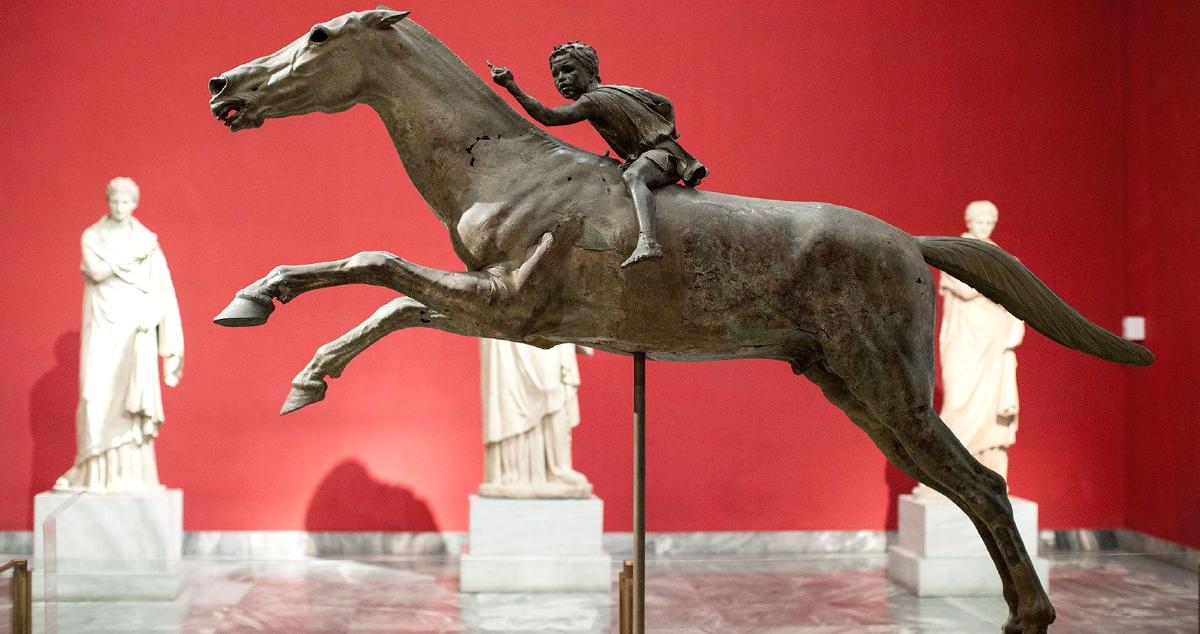
- Horse and Jockey of Artemision (Room 21). A small boy riding a galloping horse, both in bronze, both from the Artemision shipwreck. The horse’s nostrils are flared, the boy is leaning forward, and the whole thing radiates motion. It’s tiny and perfect.
Vase & Minor Arts Collection (Rooms 49–56)#
If you’re not already into Greek pottery, this section might surprise you. These aren’t dusty clay pots — they’re illustrated stories painted with extraordinary skill.
Don’t miss:
- The Dipylon Amphora (Room 49). A massive geometric-period vase (8th century BC) that stood as a grave marker. The band of mourning figures around the middle is one of the earliest narrative scenes in Greek art.
- Red-figure and black-figure vases. Look for scenes of daily life — athletes training, women at the fountain, symposium drinking games. These are windows into ordinary Greek existence in a way that sculpture and architecture aren’t.
- Gold jewelry and bronze mirrors. The metalwork in the minor arts cases shows astonishing precision — filigree earrings, wreaths of golden oak leaves, carved gemstones used as signet rings.
Egyptian Collection (Rooms 40–41)#
A compact but well-curated collection of Egyptian artifacts, many acquired in the 19th century. It’s small enough to see in 15 minutes and offers a nice change of pace.
Highlights: A gilded wooden coffin, bronze statuettes of Osiris and Isis, scarabs, and ushabti figurines. Not a reason to visit on its own, but worth a quick detour if you’re already here.
The Antikythera Mechanism (Room 38)#
This gets its own section because it deserves one.
In 1901, sponge divers found a corroded lump of bronze in a Roman-era shipwreck near Antikythera. It sat in a storeroom for decades before researchers realized what it was: an analog computer, built around 100 BC, with interlocking gears designed to predict eclipses, track the Olympic cycle, and model the movements of the sun and moon.
Let that sink in. Gears. In 100 BC. Nothing this sophisticated appeared again in the archaeological record for over a thousand years.
The display includes the surviving fragments — they’re not much to look at, honestly, just greenish corroded metal — alongside reconstructions and explanations of how the mechanism worked. The interactive displays are excellent.
Practical Visitor Tips#
How Much Time Do You Need?#
- Speed run (1.5 hours): Prehistoric collection (Mycenaean gold, Akrotiri frescoes), Artemision Bronze, Antikythera Mechanism. Skip everything else.
- Good visit (2–3 hours): Add the sculpture galleries and vase collection.
- Deep dive (3–4 hours): Everything, including the Egyptian rooms and temporary exhibitions.
Most visitors are satisfied with 2–3 hours.
Cloakroom & Bags#
Free cloakroom at the entrance. Large bags and backpacks must be checked — you can’t bring them into the galleries. Small shoulder bags and purses are fine.
The Museum Cafe#
There’s a small cafe in the garden courtyard with coffee, cold drinks, and light snacks. Nothing fancy, but it’s pleasant to sit outside under the trees between gallery sessions. Prices are reasonable by museum-cafe standards (coffee €2.50–4).
Photography#
Photos and videos are allowed throughout the permanent collection. No flash, no tripods, no selfie sticks. The lighting in some rooms is dim, so your phone camera may struggle — the bronze rooms are particularly tricky.
Best Days and Times#
- Best: Tuesday through Thursday mornings (10 AM–noon). The museum is quietest midweek.
- Good: Any weekday afternoon.
- Busiest: Weekends, Monday afternoons (it opens late on Mondays), and free-entry days.
Nearby: What Else Is Around#
The museum sits at the border of several interesting Athens neighborhoods. Here’s what’s nearby.
Exarcheia (5-minute walk east)#
Athens’ bohemian quarter — street art, vinyl record shops, university students, indie cafes, and some of the best souvlaki in the city. It’s grittier than Plaka but far more authentic. Check our Athens neighborhoods guide for more.
Omonia & the Central Market (10-minute walk south)#
Omonia Square has been cleaned up significantly in recent years. The Varvakios Central Market (Athens’ main food market) is a 10-minute walk south — a great sensory experience if you’re into food. Stalls sell fresh fish, meat, spices, and olives. The surrounding streets have old-school tavernas where locals eat lunch.
National Garden & Syntagma (20-minute walk south)#
Keep walking south on Patission (which becomes Panepistimiou) and you’ll reach the neoclassical trilogy of the University, Academy, and National Library, then Syntagma Square and the National Garden. A pleasant walk, and it connects you back to central Athens.
Combine with Other Museums#
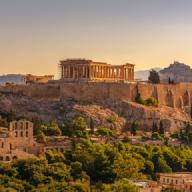
If you’re doing a museum day, pair the National Archaeological Museum with the Acropolis Museum — they complement each other perfectly. The Archaeological Museum covers everything before and beyond the Acropolis era, while the Acropolis Museum zooms in on the hilltop itself. Together, they tell the complete story of Greek civilization.
See our best museums in Athens guide for the full lineup.
Frequently Asked Questions#
How much are National Archaeological Museum tickets in 2026?#
The standard adult ticket is €12. Reduced tickets (EU seniors 65+, non-EU students with ISIC) are €6. Children under 18, EU students with valid ID, and ICOM members get in free. Tickets are purchased at the entrance — there’s no need to pre-book.
What are the National Archaeological Museum opening hours?#
Tuesday through Sunday: 8 AM–8 PM (summer season, April–October). Monday: 1 PM–8 PM. Winter hours (November–March) are usually shorter — typically closing at 3 PM or 5 PM. Always check the museum’s official website before visiting, as hours change with the seasons and around holidays.
What is the most famous exhibit at the National Archaeological Museum?#
The Mask of Agamemnon is the museum’s most iconic piece — a gold funerary mask from a Mycenaean shaft grave dating to around 1550 BC. Other world-famous highlights include the Artemision Bronze (a monumental bronze statue of Zeus or Poseidon), the Antikythera Mechanism (an ancient analog computer), and the Akrotiri frescoes from Santorini.
How long do you need at the National Archaeological Museum?#
Most visitors spend 2 to 3 hours. A focused highlights-only visit (Mycenaean gold, Artemision Bronze, Antikythera Mechanism) can be done in 1.5 hours. If you want to see everything including temporary exhibitions, plan for 3 to 4 hours.
Is the National Archaeological Museum worth visiting?#
Absolutely. It’s the largest archaeological museum in Greece and one of the most important in the world. If you care even a little about history, ancient art, or understanding what made Greek civilization remarkable, this museum delivers on a level that few others can. The Mycenaean gold alone is worth the trip.
How do I get to the National Archaeological Museum from the Acropolis?#
The easiest route is metro Line 1 (green) from Monastiraki or Thissio to Victoria station — about 15 minutes including the walk. Alternatively, take Line 2 (red) from Akropoli to Omonia, then walk 10 minutes north on Patission Street. A taxi from the Acropolis area costs around €5–7.
Plan Your Visit#
The National Archaeological Museum is one of those places that reshapes how you think about the ancient world. It’s not just “old stuff in glass cases” — it’s gold masks that someone hammered over the face of a dead king 3,500 years ago, bronze statues hauled from shipwrecks that sat on the ocean floor for two millennia, and an ancient computer that nobody fully understands even now.
Give it a proper morning. Pair it with lunch in Exarcheia. Then spend the afternoon at the Acropolis or exploring free things to do in Athens.
More Athens planning: