If the Acropolis is where ancient Athens flexed its power, the Peloponnese is where the rest of Greek civilization happened. Mycenae, where Agamemnon ruled before sailing off to Troy. Epidaurus, where a theater built 2,300 years ago has better acoustics than most modern concert halls. Nafplio, a Venetian port town so charming it makes you want to cancel the rest of your trip and just stay.
All of it is 1.5-2 hours from Athens. An easy day trip. And somehow, a lot of visitors skip it entirely — which means fewer crowds and a much more personal experience than the Acropolis on a busy morning.
Here’s how to plan Peloponnese day trips from Athens, whether you book a tour or drive yourself.
Quick Overview#
| Destination | Distance | Drive Time | Highlights | Best For |
|---|---|---|---|---|
| Corinth Canal | 80 km | 1 hour | Engineering marvel, photo stop | Everyone (it’s on the way) |
| Mycenae | 120 km | 1.5 hours | Lion Gate, ancient citadel, royal tombs | History lovers |
| Epidaurus | 130 km | 2 hours | Perfect ancient theater, acoustics | Architecture, culture |
| Nafplio | 140 km | 2 hours | Venetian fortress, old town, seaside | Couples, photographers |
| Ancient Corinth | 85 km | 1 hour | Temple of Apollo, Roman ruins, Acrocorinth | History, biblical interest |
The Most Popular Route: Mycenae + Epidaurus + Nafplio#
Most organized tours combine these three into a single full-day trip, often with a quick stop at the Corinth Canal on the way. This is the route I’d recommend for first-timers — you get ancient history, stunning architecture, and a beautiful town, all in one day.
Here’s how the day typically unfolds:
7:30-8:00 AM — Leave Athens, drive through the Peloponnese countryside 9:00 AM — Quick photo stop at the Corinth Canal 10:00 AM — Mycenae (1.5-2 hours exploring) 12:30 PM — Lunch in Nafplio 2:00 PM — Free time in Nafplio (1-1.5 hours) 3:30 PM — Epidaurus (1-1.5 hours) 5:00 PM — Drive back to Athens 7:00 PM — Back in Athens
From Athens: Mycenae, Epidaurus & Nafplio Full-Day Tour
The classic Peloponnese day trip with expert guide, comfortable bus, and visits to all three major sites plus a Corinth Canal photo stop. Lunch break in charming Nafplio. Running for decades and consistently top-rated.
Also on Viator: Book this tour on Viator →
The Sites: What You’ll See (And Why It Matters)#
Corinth Canal#
Most tours stop here for 15-20 minutes, and honestly, that’s all you need. But those 15 minutes are worth it.
The canal is a 6-kilometer cut sliced straight through solid rock, connecting the Gulf of Corinth to the Aegean Sea. It’s only 24 meters wide — some of the ships that pass through barely fit. Looking down from the bridge is dizzying. The walls rise 90 meters on either side, perfectly vertical, and the water far below is a surreal shade of blue-green.
The ancient Greeks first dreamed of building it. Emperor Nero tried in 67 AD with 6,000 slaves. It wasn’t actually completed until 1893. Standing there, you understand why it took so long.
Time needed: 15-20 minutes (photo stop) Entry: Free (you view from the bridge)
Mycenae — The Citadel of Agamemnon#
This is the one that gets under your skin. Mycenae doesn’t have the visual drama of Delphi or the photogenic perfection of Santorini. What it has is weight. The stones here are 3,400 years old, and they feel it.
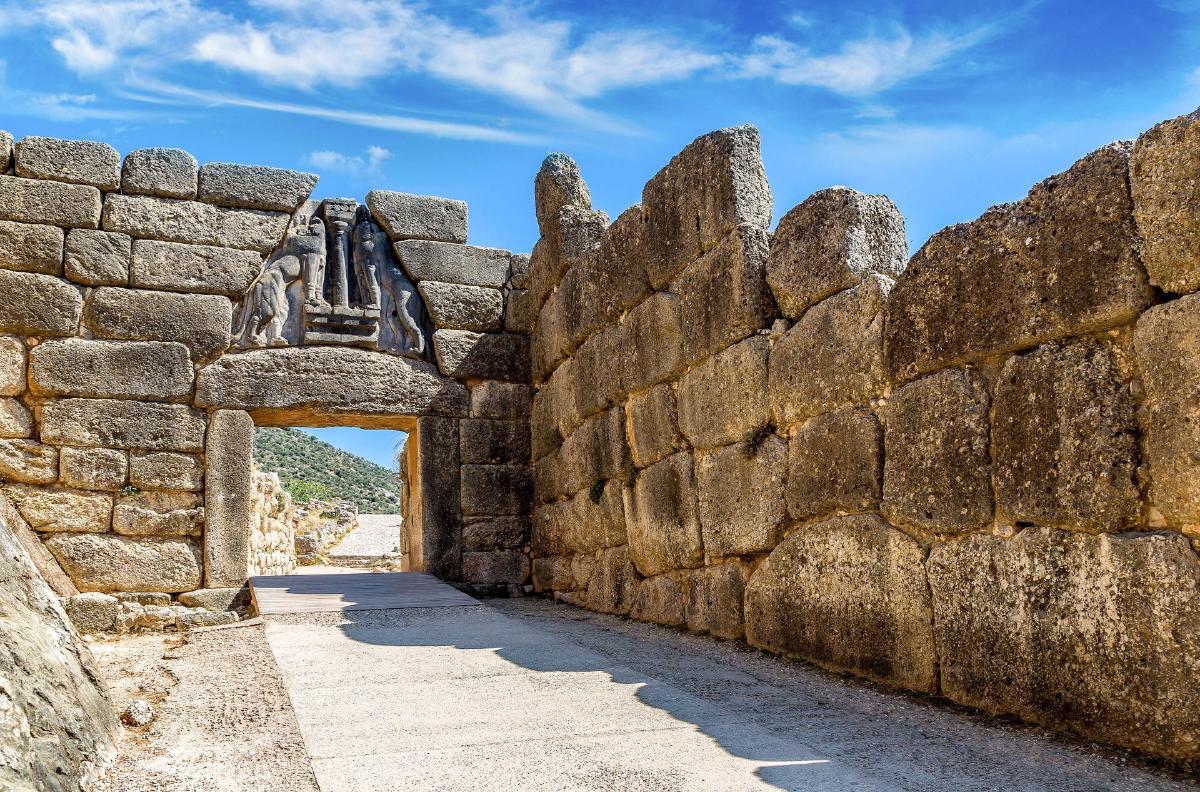
This was the seat of power for the Mycenaean civilization — the people who fought the Trojan War, if Homer is to be believed. The Lion Gate, the main entrance to the citadel, is one of the most iconic images in archaeology. Two massive stone lions guard the entrance, carved into a triangular relief above the doorway, and walking through it you can almost feel the thousands of years of people who’ve passed the same way.
What you’ll see:
- The Lion Gate — Europe’s oldest monumental sculpture. Still standing after 3,200 years. Still impressive.
- Grave Circle A — Where Heinrich Schliemann found the gold funeral masks, including the famous “Mask of Agamemnon” (the original is in Athens’ National Archaeological Museum)
- The Citadel — Walk up through the ruins of the palace complex with views across the Argolid plain
- Treasury of Atreus (Tomb of Agamemnon) — A massive beehive-shaped tomb just outside the citadel. The engineering is mind-blowing for 1250 BC.
- Museum — Small but excellent, with pottery, weapons, and jewelry from excavations
Entry: €12 (includes museum and Treasury of Atreus) Time needed: 1.5-2 hours
Epidaurus — The Theater That Defies Physics#
I’m going to tell you something that sounds too good to be true: at the Epidaurus theater, someone can stand on the top row — seat 14,000 out of 14,000, sixty rows up — and hear a coin drop on the stage below. No microphone. No amplification. Just 2,300 years of acoustic engineering that modern scientists still debate.
The theater is the main event here, and rightfully so. It’s the best-preserved ancient Greek theater in existence. The proportions are mathematically perfect, the setting against green hills is gorgeous, and the experience of standing in the center of the orchestra (the circular stage) and speaking in a normal voice while your friends confirm they can hear you from the top row… it just never gets old.
What you’ll see:
- The Great Theater — 14,000 seats, perfect acoustics, built around 340 BC. Test the acoustics yourself — it’s not a gimmick, it genuinely works.
- Sanctuary of Asklepios — This was ancient Greece’s most famous healing center. People came from across the Mediterranean hoping to be cured. The ruins include temples, a gymnasium, and a mysterious circular building called the Tholos.
- Museum — Reconstructed elements, surgical instruments (ancient Greeks did surgery here), and offerings left by healed patients
Entry: €12 Time needed: 1-1.5 hours
Summer bonus: The Athens & Epidaurus Festival (June-August) stages ancient Greek dramas in this theater under the stars. If your trip overlaps, this is a bucket-list experience. Check the Hellenic Festival website for the schedule.
Nafplio — Greece’s Most Charming Town#
After ruins and theaters, Nafplio is a palette cleanser. This was Greece’s first capital (1827-1834, before Athens took over), and it has the architecture to prove it — Venetian mansions, Ottoman fountains, neoclassical facades, all crammed into narrow cobblestone streets that spill down to a waterfront lined with cafes.
Most tours give you 1-1.5 hours of free time here, including lunch. That’s enough to eat, walk the old town, and fall slightly in love with the place. If you’re driving yourself, consider spending a full afternoon.
Don’t miss:
- Syntagma Square — The central square, great for a coffee and people-watching
- The Old Town streets — Wander aimlessly. Every alley has something photogenic.
- Bourtzi — A small Venetian fortress sitting on an island in the harbor. You can see it from the waterfront. Boats take you there in summer (€5).
- Palamidi Fortress — 999 steps to the top for panoramic views. Only attempt this if you have time and strong legs. The view is spectacular.
- Gelato — Nafplio has surprisingly excellent Italian-style gelato. Multiple shops on the main streets.
Best for: Lunch stop, photography, couples, anyone who appreciates beautiful small towns
Other Peloponnese Day Trips Worth Considering#
Ancient Corinth + Acrocorinth#
If biblical history interests you, or if you want a less crowded alternative to Mycenae, Ancient Corinth is excellent. This is where St. Paul lived and preached for 18 months. The Temple of Apollo (6th century BC) still has standing columns, and the ruins of the Roman marketplace are extensive and well-preserved.
Above the ancient site looms Acrocorinth — a massive fortress on a 575-meter hill that was used from ancient times through the Ottoman period. The views from the top are jaw-dropping.
Ancient Corinth Day Trip with Canal & VR Guide
Visit the Corinth Canal and Ancient Corinth with VR-enhanced audio guide that brings the ruins to life. Small group, air-conditioned minibus, and plenty of time to explore.
Nemea Wine Region#
Wine lovers, take note. Nemea is the Peloponnese’s premier wine region, famous for Agiorgitiko — a rich, velvety red grape that’s been growing here since ancient times. Several tours combine a Nemea winery visit with Corinth or Mycenae for a day that mixes culture with excellent wine.
We cover Nemea in detail in our Athens wine tasting guide.
Tour vs. Self-Drive: Which Should You Pick?#
Go With a Tour If:#
- You don’t want to drive in Greece (fair — Greek driving can be intense)
- You want a guide to explain what you’re seeing (Mycenae is much more meaningful with context)
- You’re a solo traveler or couple (tours handle all logistics)
- You want a fixed schedule so you don’t spend the whole day at one site
Drive Yourself If:#
- You want flexibility (spend 3 hours in Nafplio instead of 1)
- You’re comfortable with European driving
- You want to combine sites in a custom order
- You want to stop at places tours skip (local tavernas, viewpoints, beaches)
Driving tips: The Athens-Corinth highway (A8) is modern and fast. After the Corinth Canal, roads narrow but are well-maintained. Parking is free at all archaeological sites. GPS works well. Gas stations are frequent.
Small Group vs. Large Bus Tour#
| Small Group (8-15) | Large Bus (30-50) | |
|---|---|---|
| Price | €90-130 | €70-100 |
| Flexibility | More time at each stop | Fixed schedule |
| Guide quality | Usually better (more personal) | Varies |
| Comfort | Minibus, more legroom | Large coach, AC |
| Best for | People who want depth | Budget-conscious travelers |
Small-Group Mycenae, Epidaurus & Nafplio Tour
Small group experience (max 15 people) with audio guide and more time at each site. Includes Corinth Canal stop, Mycenae, Epidaurus theater, and free time in Nafplio.
Also on Viator: Book a small-group Peloponnese tour on Viator →
Practical Tips#
Start early. Tours leave Athens at 7:30-8:00 AM. If driving, leave by 8 AM to beat the heat at Mycenae.
Wear proper shoes. Mycenae has uneven ground, loose gravel, and steep paths. Epidaurus is easier but still involves walking on stone. Sneakers minimum, hiking shoes ideal.
Bring water and snacks. There are small cafes at Mycenae and Epidaurus, but selection is limited and overpriced. A reusable water bottle will save you.
Mycenae first, Epidaurus second. If driving yourself, do Mycenae in the morning (less hot, the hilltop has no shade) and Epidaurus in the afternoon (it’s shaded and cooler). Lunch in Nafplio in between.
Check the Epidaurus Festival schedule. If your trip falls between June and August, you might be able to catch an evening performance of a Greek tragedy in the actual theater. It’s extraordinary.
Bring layers in spring/autumn. The Peloponnese interior can be 5-10°C cooler than Athens, especially in the mornings.
Allow for traffic. The highway out of Athens can be congested until you pass the Elefsina toll. Budget an extra 20-30 minutes in the morning.
Consider an overnight. Nafplio is worth a full evening. If you can spare two days, sleep there and explore at a relaxed pace. The town is magical at night.
Frequently Asked Questions#
Can I visit Mycenae, Epidaurus, and Nafplio in one day?#
Yes, and this is actually the most common way to do it. Tours have been running this circuit for decades. You’ll have 1.5-2 hours at Mycenae, about an hour at Epidaurus, and 1-1.5 hours in Nafplio. It’s busy but very doable.
Is Mycenae worth visiting?#
If you have any interest in ancient history, absolutely. It’s one of the most important archaeological sites in Europe — the center of a civilization that shaped Greek mythology and the Trojan War saga. It’s not as visually dramatic as Delphi, but the historical weight is immense.
How does this compare to a Delphi day trip?#
Different vibes entirely. Delphi is more visually dramatic (mountain setting, ancient oracle atmosphere). The Peloponnese circuit gives you more variety — three different sites plus a charming town. If you can only do one day trip, it’s a tough call. If you have two days, do both.
Can I do this by public bus?#
Technically yes, but it’s complicated. KTEL buses run to Nafplio and Mycenae, but combining all three sites in one day by bus is logistically difficult. I’d recommend a tour or rental car for this circuit.
Is this trip good for kids?#
Mycenae’s Lion Gate and tombs fascinate most kids (especially those into mythology). Epidaurus’ acoustics demo is always a hit. Nafplio has gelato and a harbor with boats. So yes — better than many archaeological day trips.
How much does it cost on my own?#
If driving: €20-30 for highway tolls, €12 each for Mycenae and Epidaurus entry, €15-20 for gas, plus lunch. Total: about €60-80 per person for two people, significantly less than a tour — but you miss the guide’s expertise.
The Bottom Line#
First time in Greece and want the full experience? Book the Mycenae + Epidaurus + Nafplio tour. It’s the most complete Peloponnese day trip, and having a guide at Mycenae makes a real difference.
Want something smaller and less rushed? Focus on Nafplio + Epidaurus if you love charming towns, or Mycenae + Corinth if you’re primarily into ancient history.
Short on time? The Corinth Canal + Ancient Corinth combo works as a half-day trip and gets you into the Peloponnese with less commitment.
The Peloponnese often lives in the shadow of the Greek islands in people’s travel plans. That’s a mistake. Some of the most powerful historical sites in Europe are sitting an hour and a half from Athens, with a fraction of the Acropolis crowds. Don’t skip them.
Want more day trip ideas? See our guides to the best day trips from Athens, Delphi tours, and Meteora day trips.